Showing posts with label Cadw. Show all posts

Saturday, 4 August 2018

A hidden gem in the Usk Valley


I have lived in Wales for more than twenty years now and, although I am still stumbling upon new treasures, there are some places that I find myself returning to time and time again. One of my favourites is Tretower Court.  It sits in the green Usk Valley between Abergavenny and Brecon, seemingly untouched, timeless.

When compared with the tourist hot spots like Pembroke and Conwy castles the site is small but this simply adds to the atmosphere. The noise of the traffic dwindles and all you can hear is birdsong and the sporadic bleating of sheep. A few years ago Tretower was little known and I’d find myself the only person there, with the ghosts of the past whispering in my ear.

Tretower marks the period when castles were abandoned in favour of more comfortable, less fortified homes. There are two distinct sites at Tretower, each as valuable in their own way as the other: the later medieval house and, two hundred yards to the north-west, the remains of the 12th century castle stronghold, the round tower being added later in the period.

Although the more domestic Court building was erected early in the fourteenth century, later additions to the Tower suggest that the stronghold was not entirely abandoned at this time. Should the house have come under attack the inhabitants would simply gather up their possessions, round up the livestock, and take cover behind the impregnable walls of the tower.

The earliest part of medieval house is the north range, which dates from the early fourteenth century. The masonry and latrine turret on the west end may even have been built as early as 1300. The four major phases of building can clearly be seen from the central courtyard as can the later modifications added as late as the seventeenth century. As you move from room to room, duck through low doorways, climb twisting stairways and creep into the dark recesses of the latrine turrets you are not alone. So much has happened here, so many people have passed through, so much laughter has rung out and so many tears have fallen. It is a jewel for any writer, I can smell the stories still waiting to be told.

A motte and bailey was raised by a Norman follower by the name of Picard. The property passed through the family’s male line until the fourteenth century when it moved, via the female line, to Ralph Bluet and then, again through the marriage of another daughter, to James de Berkeley.
His son, also James, became Lord Berkeley on the death of his uncle. Tretower was later purchased from James by his mother’s husband, Sir William ap Thomas. Sir William’s second wife, Gwladys, gave him a son, William Herbert, later the earl of Pembroke, who inherited both Tretower and Raglan Castle on his father’s death. Tretower was later gifted to William’s half-brother, Roger Vaughan the younger, around 1450.

Herbert and Vaughan both played important roles during the Wars of the Roses. William Herbert was both friend and advisor to Edward IV and his career prospered until 1469 when he was executed following the Yorkist defeat at Edgecote.

Roger Vaughan, who was responsible for most of the major reconstruction of Tretower Court, was knighted in 1464, and present as a veteran at Tewkesbury and finally captured at Chepstow. There, he was executed by Jasper Tudor in an act of vengeance for beheading his father, Owen Tudor, ten years previously. Tretower remained in the possession of the Vaughans until the eighteenth century when it was sold and became a farm.

Years of neglect and disrepair followed and it was not until the twentieth century that preservation and repair work began. The reconstructions at Tretower are beautifully done, the living history displays that take place there providing deeper knowledge of how the dwelling was utilised.


The garden with its relaxed medieval planting is as beautiful as any I have seen is this country. Laid out and designed by Francesca Kay, it has a covered walk way, tumbling with red and white roses, fragrant lavender, aquilega, foxgloves and marigold sprawl beside a bubbling fountain in the midst of a chequered lawn. 

I spent a long time here on a warm Sunday morning in July, wandering through the rose arbour, lingering in the orchard before returning to the house. As I progressed along the dim corridors I could almost hear the skirts of my gown trailing after me on the stone floors. I paused, and time was suspended as I looked through thick, green glass to the courtyard and garden below.


If you ever have the good fortune to visit Wales, make the time to call in at Tretower and don't forget to bring a picnic and a blanket for I guarantee you will want to linger.


More information about Judith Arnopp and her books can be found on her website:
http://www.judithmarnopp.com
or her author page author.to/juditharnoppbooks

Tuesday, 10 June 2014

Raglan Castle Tudor Weekend - A Review


Raglan from the top of the tower

On our return from Raglan Castle's Tudor Weekend I wanted to sit down straight away and blog about the fabulous time we had but life got in the way and I am a little behind. After a busy couple of weeks promoting my latest novel Intractable Heart: the story of Katheryn Parr at last I have a spare few moments.

Me - shamefully cross laced
Two weeks ago my old fella and I got into our Tudor best and took a trip to Raglan Castle to sell books, meet the public and generally have a lot of fun. The weather for once was perfect, dry, not too hot, not too cold and the company was great. 
A family group
Neither of us had done this before and had no idea what to expect. Sometimes when you enter a new social arena you can feel out of place, not one of the crowd, a little gauche, but there was none of that at Raglan. As soon as we arrived on site we were given a lovely welcome from custodian Jane Mcilquham who quickly introduced us to the others. And what a lovely bunch they are.

Jane Mcilquham - custodian
There were various stalls and a medieval style bar, The Stagger Inn, plenty of refreshments on offer.
Under the banner of the White Boar
We decked our gazebo in medieval bunting and set out our wares right next to Henry VIII who, just as Henry liked to do, sometimes masqueraded as Minstrel Tom, entertaining the crowd with his music. 
 
Nathen Amin signing copies of his book
On our other side was Nathen Amin, signing copies of his guide book Tudor Wales which, as the title suggests, lists all the Tudor attractions in Wales.  Also nearby was photographer, Louise Burrows with a selection of her lovely photographs and cards, and Marion Davies who is better known as Mistress Grott was selling cures and curiosities. I bought a stick weaving kit and am now embarked on yet another handicraft.

A fair maiden
Raglan Castle is truly splendid; a proud building even now after years of wars and neglect, and the splendour was enhanced by the presence of two re-enactment groups, The Armourial Knights and the Beaufort Companye who staged some stunning events. 

Courtly love comes to Raglan
The costumes and attention to detail of both communities is unsurpassed, their camps acting as a portal to another time and place. I saw people of all ages, from small children to elderly women, and all were wearing authentic costume, embellishing the whole event and turning the day into an ‘experience.’ 

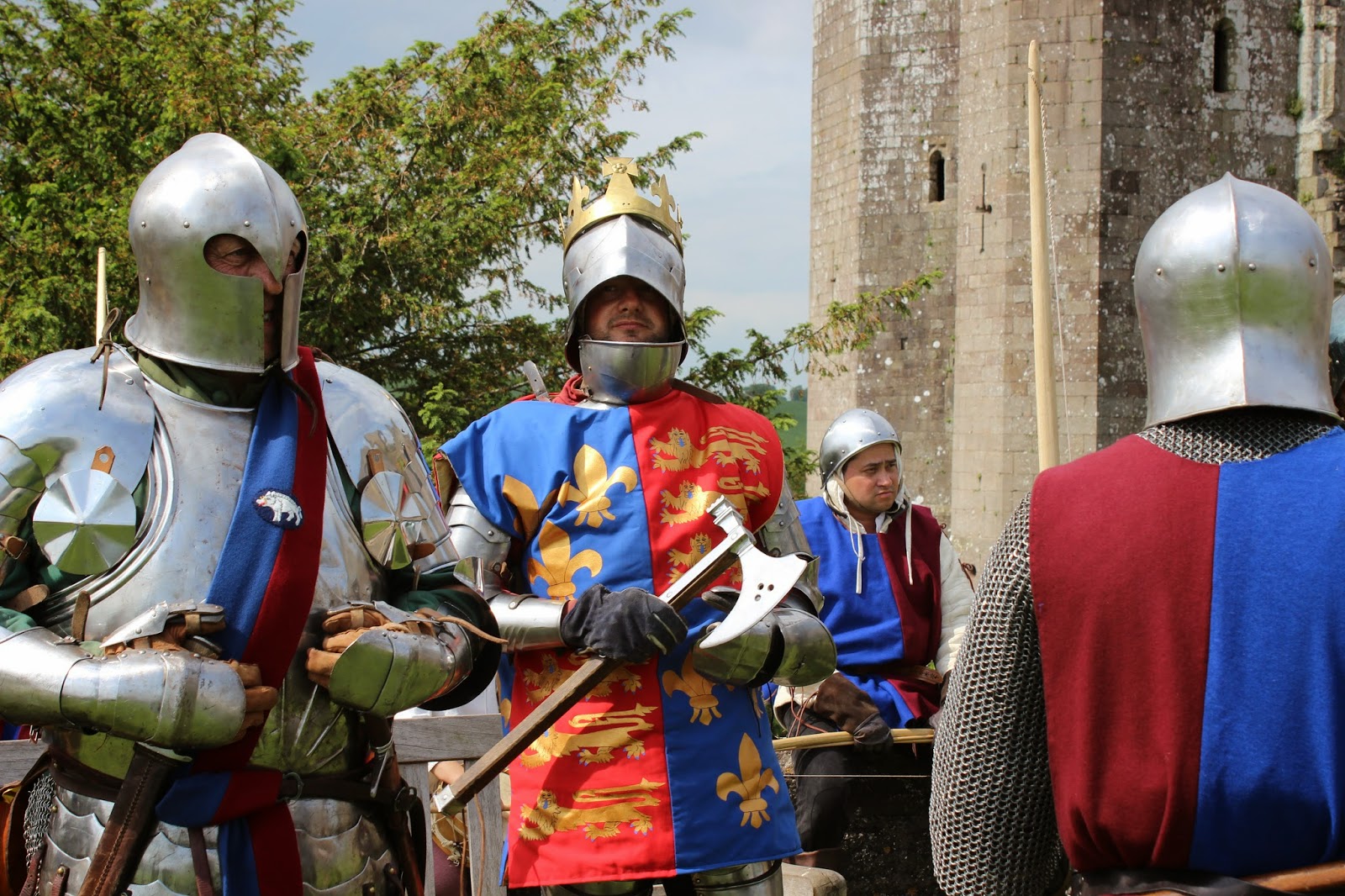
King Richard III waiting for the battle
Walking with my camera I came upon a company of knights on their way to Bosworth Field and I felt I was in a setting from one of my novels. I am very certain that many of the characters and scenes I saw at Raglan will be resurrected and used in my future work.

A family group
There was plenty of scope. I saw a mock execution, a re-enactment of the Battle of Bosworth, listened to a talk by historian Emma Knight on Anne Boleyn. There was falconry, spinning displays, a Tudor trail for the kids to educate them subliminally as they move around the castle, helping them learn the fun way. 

Henry VIII figuring out how to put on his own hat
I met several of my heroes and a good few foes; Richard III, Henry VII, Henry VIII, The Stanleys … for me it was seventh heaven.

Richard - still waiting
I am a retiring sort of person and I went to Raglan with some reservation but I will not hesitate to go again. It was brilliant to meet my readers face to face and hear their enthusiastic feedback for my work. Next time, if you can't find me signing my novels, The Kiss of the Concubine, Intractable Heart, and The Winchester Goose, I will be somewhere in the crowd feasting on Welsh cakes and soaking up the atmosphere. 
Hope to see you there.
A gathering
 Judith Arnopp is the author of six historical novels. 
Click here to read more about her work.

Wednesday, 7 May 2014

Raglan Castle - A Tudor Weekend 31th May - 1 June, 2014


By Bob McCaffrey from Rickmansworth, UK (Raglan Castle (2)) [CC-BY-SA-2.0 (http://creativecommons.org/licenses/by-sa/2.0)], via Wikimedia Commons
Most people today see Raglan Castle in a blur as they dash past it on the A40 just outside Abergavenney in Monmouthshire. The castle serves as a reminder of our heritage, a ghost of late medieval Britain that watches in bemusement as we scurry by on our frantic modern business.
But, in its heyday, Raglan Castle would have been a destination in itself. A weary traveller on the old medieval route through the village would have been overawed by the vast crenelated towers as they appeared dramatically over the brow of the hill. He would then be forced to take the path circling the castle. Constrained to ride around the Great Tower and moat, he could not help but notice the impenetrable walls, the defensive towers, the soaring gatehouse. Once inside he would have looked up at vast walls that shadowed the sun, to see fluttering pennants against the clear blue sky. He would have craned his neck at the carved stone badges and shields above the gate expressing the awesome power of the Earl. Only then would he pass through to the inner Fountain Court to discover another entrance, this time to the Great Tower and the Family’s living quarters. All this was designed to impress, put a visitor on his guard, and make any prospective enemy think again.
Philip Halling [CC-BY-SA-2.0 (http://creativecommons.org/licenses/by-sa/2.0)],
The castle we see today was begun in 1415 by William ap Thomas, a veteran of Agincourt, who purchased the manor of Raglan for one thousand marks. It was William who conceived the basic shape of the castle although much of the building work took place after his time.
William’s son dropped the ap Thomas and began to call himself William Herbert. He was active on the side of York during the Wars of the Roses and also fought in the Hundred Years War. It was William Herbert who carried out most of the medieval phase of the building and added extensive parkland, orchards and fishponds. As a Yorkist supporter Herbert’s fortunes flourished and in 1461 Edward IV made him Lord Herbert of Raglan. 

In 1461 at the Battle of Mortimer’s Cross Herbert’s half-brother, Henry Vaughn, captured the Lancastrian, Owen Tudor, father of Jasper and grandfather of Henry, and executed him in Hereford. Owen’s son Jasper was forced to flee the country, leaving his nephew, Henry Tudor, behind at Pembroke castle.
Sir William Herbert.

In 1468 Herbert became the first Welshman to be made an Earl; the Earl of Pembroke, replacing the now attainted Lancastrian, Jasper Tudor. He also became Justice and Chamberlain of South Wales and one of the King’s closest advisors and friends.
Henry VII
He was given custody of the young Lancastrian heir, Henry Tudor (later Henry VII) and the boy spent much of his childhood at Raglan while his uncle Jasper Tudor agitated for the return to a Lancastrian rule. Although held as a prisoner Henry was gently treated, receiving an education and instruction in military skills.

But William Herbert’s fortunes did not last and after the Battle of Edgecote Moor in 1469 Herbert, along with his brother Robert, was executed. His daughter Elizabeth married Charles Somerset, a natural son of Henry Beaufort, third Duke of Somerset, and with her, the castle passed into the hands of a new family. Over the course of a few generations the Somersets added Pitched Stone Court, the Hall, the Long Gallery and developed the gardens in the new Renaissance style fashion.


The architecture at Raglan marks the transition of British castles from defensive structures into homes for the rich and powerful. Raglan is distinctive in the aesthetic details like fireplaces and windows, added in the Tudor period. Fountain Court takes its name from a magnificent black marble fountain featuring a white marble horse that once took centre place; its ostentation can now only be imagined. The fabulous oriel window and the great stair which gave access to the family apartments above would have been outstanding in their day. The workmanship of the stonemasons is a clear sign that the custodians of Raglan employed only the best craftsmen.
Raglan saw little battle action until the Civil War when it was held under siege by the parliamentarians; when the castle surrendered General Fairfax ordered it to be completely destroyed under the supervision of Henry Herbert, a direct descendent of William ap Thomas, the castle’s founder.


Fortunately the castle was not easy to destroy (or perhaps Herbert didn’t have his heart in it) and the damage was comparatively slight. Although the family regained their possessions and ownership of the castle after the restoration the building continued to slide into decay until the 20th century when it was scheduled as a listed building. It is now administered by Cadw.


But life at Raglan Castle isn’t over yet. Every year Cadw hold medieval fayres that celebrate the medieval and Tudor world. On the weekend of May 31 – June 1, 2014 Cadw are holding A Tudor Weekend. As well as enjoying the splendours of the castle, you can meet Henry VII, Henry VIII, try on a Tudor costume, hear a talk by historian Emma Knight on Anne Boleyn, and also meet me.

I will be there in my Tudor kit, signing my Tudor novels, TheWinchester Goose, The Kiss of the Concubine, and Intractable Heart, and talking to fellow Tudor enthusiasts.
I look forward to meeting you there.

You can read more about me and my work on my webpage:

Pictures from Wikimedia Commons.