Showing posts with label author. Show all posts

Thursday, 27 April 2023

Delighted to welcome Amy Maroney with news of her new book, The Queen's Scribe


The Queen’s Scribe 

by 

Amy Maroney


Queen Charlotta of Cyprus, a forgotten monarch

 While researching the Sea and Stone Chronicles, a collection of novels about ordinary people living under the rule of the Knights Hospitaller in medieval Rhodes, I stumbled across a woman of power whose story captivated me. Her name was Queen Charlotta, and she ruled the Kingdom of Cyprus for a moment in time during the exact era of my research. 

Just what the Kingdom of Cyprus was, I had no idea. So, like any overzealous historical novelist, I dove down an exhilarating research rabbit hole in search of more details.

I was astonished by my findings. The Kingdom of Cyprus, Jerusalem, and Armenia (the latter two designations were purely titular) was ruled by the French Lusignan dynasty for hundreds of years. Its zenith came in the thirteenth and fourteenth centuries. By 1458, when the fifteen-year-old, widowed Queen Charlotta ascended the throne, the Lusignan dynasty was hobbled by war and debt, and poisoned from within by corruption and betrayal. 

Queen Charlotta therefore faced a formidable set of complications when she donned her crown. She not only accepted the challenge, she exhibited tremendous ambition and courage. Less than two years after taking the throne, she moved her courtiers to the seaside fortress of Kyrenia, where they survived a massive siege by her power-hungry half-brother, Jacco. Then, when her second husband Louis of Savoy proved a weak leader, she left him in Cyprus and sailed around the Mediterranean entreating allies to help save her crown. 

Clearly, this courageous queen’s story had to be told. So I resolved to bring her to life with a novel, The Queen’s Scribe.

KYRENIA FORTRESS, WHERE QUEEN CHARLOTTA RESISTED A SIEGE BY HER HALF-BROTHER

Though her father, King Jean, was a Frenchman born into the Lusignan dynasty, Charlotta’s mother, Eleni Palaiologina, was a proud Greek woman who defied the “Latin” influence of her husband’s court. Charlotta grew up a Greek girl in her mother’s apartments, and never learned much French. 

But when Charlotta was married to Prince João of Portugal at fourteen, she was suddenly required to communicate in French (their common language). Her need for trusted interpreters would only grew stronger as time went on and she was forced to seek assistance from Western allies such as the Knights Hospitaller, the Pope, and the king of France. This is how I developed the concept of a fictional heroine serving the queen as a skilled interpreter and scribe. 

ST. HILARION CASTLE, WHERE THE ROYAL FAMILIES OF CYPRUS RETREATED FOR LEISURETIME PURSUITS

After the 1457 murder of her husband, Prince João, Charlotta faced a new betrothal. This time, her fiancé was her first cousin, Louis of Savoy. In the Greek Orthodox tradition, the marriage of first cousins doomed the bride and groom to hell. Charlotta’s mother naturally opposed the union. But as soon as she died, the marriage was on. 

Fortune’s wheel turned again when King Jean died just a few months after his wife (whether it was due to natural causes or poison was a matter of dispute). Teenaged Charlotta ascended the throne, her father’s council members whispering in her ear just as they had done with her father. Meanwhile, her half-brother, Jacco, vowed he would seize the kingdom. His plan: gain the favor of the Sultan of Egypt, raise an army, and attack Cyprus. Charlotta would spend the rest of her life fighting to preserve her throne.

I chose to tell Queen Charlotta’s tale through the eyes of fictional Estelle de Montavon, daughter of a French falconer. I first wrote a story starring her in an anthology a few years ago, and she plays a minor role in my novel Island of Gold. 

In The Queen’s Scribe, Estelle—a talented scribe and linguist—becomes as valuable as gold when the royal court retreats to Kyrenia Fortress and civil war looms between the queen and Jacco. As Queen Charlotta voyages across the Mediterranean Sea beseeching French-speaking allies for help, Estelle is at her side, witnessing every triumph and disaster along the way. 

MURAL OF A WEALTHY FIFTEENTH CENTURY FAMILY IN A CYPRUS CHURCH, WHICH SHOWS HOW PEOPLE DRESSED IN THAT TIME AND PLACE

This extraordinary queen’s ambition and courage burned brightly, but all too briefly. Like so many other women who deserve a place in history books, her story has been relegated to the shadows. I hope that The Queen’s Scribe plays a role in bringing Charlotta of Lusignan’s story back into the light.


Amy Maroney studied English Literature at Boston University and worked for many years as a writer and editor of nonfiction. She lives in Oregon, U.S.A. with her family. When she’s not diving down research rabbit holes, she enjoys hiking, dancing, traveling, and reading. Amy is the author of The Miramonde Series, an award-winning historical fiction trilogy about a Renaissance-era female artist and the modern-day scholar on her trail. Her new historical suspense series, Sea and Stone Chronicles, is set in medieval Rhodes and Cyprus.


The Queen’s Scribe is on Kindle Unlimited and is available worldwide from Amazon: https://mybook.to/QueensScribe


Social Media Links:

Website: https://www.amymaroney.com/

Twitter: twitter.com/wilaroney

Facebook: www.facebook.com/amymaroneyauthor

Instagram: www.instagram.com/amymaroneywrites/


Thursday, 31 March 2022

Thorne Moore joins us with news of a new release!

I am a big fan of Thorne Moore, and always wait in anticipation between publications so I am delighted to learn of her latest novel. Welcome to the page, Thorne, tell us all about your new one! 

Adam Winters is killed by a drunk driver. His devastated widow, Nicki, realises she is being stalked.

Offered an escape to a cottage by the sea, she and her daughter Willow arrive on the Pembrokeshire coast.

They settle into the community. But are drawn into troubles they have driven two hundred and fifty miles to avoid: family deceptions, jealousies, lies, a disappearance and a suspected killing.

Struggling to find peace with the past and truth in the present, Nicki discovers there is more than one sort of fatal collision"

Fatal Collision is a story about a woman, Nicki Bryce, trying to come to terms with the loss of her husband, killed by a drunk driver. Her agony is exacerbated by the refusal of the driver to admit his own guilt, which means that Nicki has to wait for months for the case to come to trial. The drunk driver, Denis Anderson, is clearly guilty, and Nicki is left to wonder how she would want him to be punished. Hanged, drawn and quartered? Boiled in oil? Imprisoned for life? Whatever punishment is meted out, it won’t bring her husband back. He will still be dead, those dear to him will still be grieving, and the culprit’s family will have been derailed too. What Nicki really wants is for Anderson to acknowledge his responsibility and tell the truth.

Is truth a more effective form of justice than the sort administered by the courts? Nicki comes to think so. Punishment does nothing except spread the pain further. It doesn’t heal people who are already hurting, but maybe truth and understanding will do better. Others have thought the same. The Truth and Reconciliation Commission in South Africa put acknowledgement of the truth above punishment as a response to the ending of apartheid. It rather depends on whether we think of justice as providing revenge or restitution. At least the truth will serve some purpose when other forms of justice fail. Dr Mengele, whose crimes were unspeakable in Nazi Germany, escaped any form of justice, and probably never felt any remorse, but the detailed truth of what he did is out there, ensuring his name will be reviled forever.

In Fatal Collision, Nicki’s crusade for truth leads her to try and solve mysteries haunting other people. Will they be better off knowing the truth, or will it only hurt? Ignorance is supposed to be bliss, but sometimes the not knowing is a never-ending nightmare. She just wants to help, but she doesn’t always realise what she’s getting into. Dabbling in other people’s lives can be a dangerous business.


Nicki lives in Hertfordshire, but most of the book is set in Pembrokeshire, on the northern coast, in the area where I live. She moves there temporarily with her daughter Willow, in order to get away from the scene of her own tragedy. I can’t think of a better place to come, but of course the people who belong there are every bit as liable to tragedy and trauma as anyone else, as she soon discovers.

Fatal Collision is out now in Kindle and paperback, published by Diamond Crime, available HERE  


Thorne was born in Luton and graduated from Aberystwyth University (history) and from the Open University (Law). She set up a restaurant with her sister and made miniature furniture for collectors. She lives in Pembrokeshire, which forms a background for much of her writing, as does Luton.

She writes psychological mysteries, or "domestic noir," exploring the reason for crimes and their consequences, rather than the details of the crimes themselves. and her first novel, "A Time For Silence," was published by Honno in 2012, with its prequel, "The Covenant," published in 2020. "Motherlove" and "The Unravelling" were also published by Honno. "Shadows," published by Lume, is set in an old mansion in Pembrokeshire and is paired with "Long Shadows," also published by Lume, which explains the history and mysteries of the same old house. She's a member of Crime Cymru. Her latest crime novel, "Fatal Collision is published by Diamond Crime (2022)

She also writes Science Fiction, including "Inside Out" (2021) and "Making Waves" (2022)


Sunday, 7 March 2021

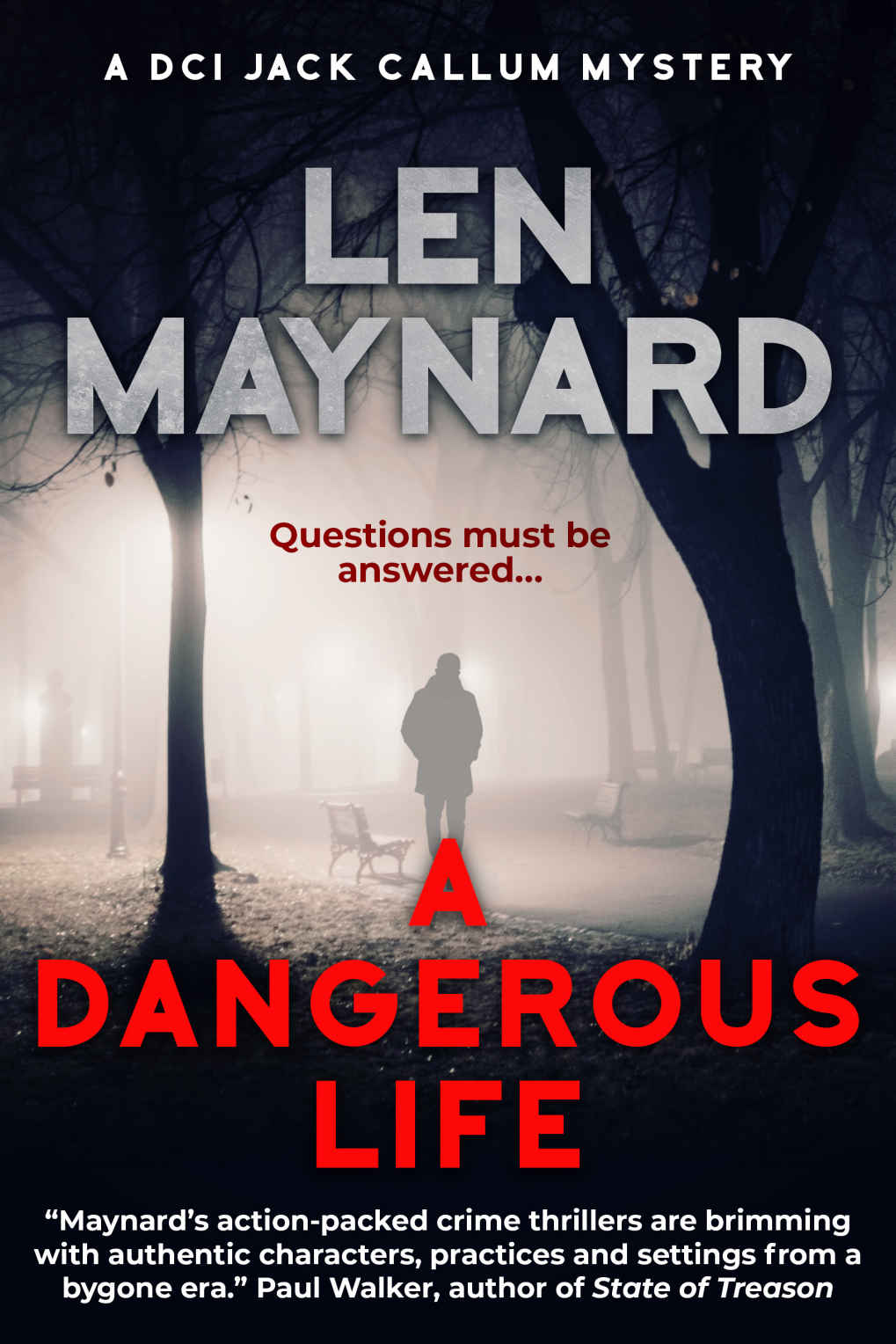
Introducing Len Maynard and his fabulous book: A Dangerous Life (DCI Jack Callum Mysteries Book 2)


 A Dangerous Life 

(DCI Jack Callum Mysteries Book 2)

By Len Maynard


Len Maynard was born in Enfield, North London in 1953, he has written and published over forty books, the majority of them in collaboration with Michael Sims. Ghost story collections, the Department 18 series of supernatural thrillers, stand-alone horror novels, the Bahamas series of action-adventure thrillers, as well as a handful of stand-alone thrillers. As editors they were responsible for the Enigmatic Tales and Darkness Rising series of anthologies, as well as single anthologies in the horror and crime genres. The DCI Jack Callum Mysteries are his first to be written under his own name.


Blurb

1959

A body of a man wearing theatrical make up is found hanging from a tree on Norton Common in Hertfordshire. He has been tortured and his throat has been cut.

DCI Jack Callum, a veteran policeman with his own rules for procedure, heads the investigation into this puzzling crime. The clues lead him close to the answer, but the solution remains elusive.

Why was the man killed?

What were the victim’s links to London’s gangland bosses?

When an unsolved murder is uncovered that appears to be connected to the case, Jack realises he must use his team to their full strength to separate the innocent from the guilty.

Jack also faces a challenge he never expected as he is accused of an improper relationship with a young Detective Constable on his team, Myra Banks.

In a breathless climax, Myra puts her own life on the line to deal with a figure from Jack’s past, who has now become a lethal threat in the present.


An excerpt from A Dangerous Life (DCI Jack Cullum Mysteries Book 2)

TUESDAY MARCH 17TH 1959

“…So it’s important you remember these three simple rules. One, don’t talk to strangers. Two, never go off with anyone you do not know personally, and three, remember that the police are your friends. We are here to listen and help you whenever we can.” Jack Callum looked up from his notes on the dais at the rows of faces staring back at him with expressions of total apathy.

Cynthia Arnold, the school’s headmistress, sprung to her feet and walked to the front of the stage.

“Very informative,” she said. “I’m sure, School, that you would like to show your appreciation to Chief Inspector Callum for giving up his valuable time to speak to you today.” She started a round of applause that rippled listlessly around the assembly hall and quickly died. “Now, if you could all make your way out, in an orderly fashion, to the playground, where…” She looked down at the piece of paper clutched in her hand. “Where Sergeant Grant and Constable Cooper will explain to you how you can stay safe on our roads.”

There was a hubbub of grumbling voices and shuffling feet as the hall gradually emptied.

“Thank you for that, Mr. Callum,” the headmistress said. “I’m sure your words found a receptive audience.”

“Well, those that stayed awake for long enough might have learned something,” Jack said as he folded his speech and tucked it into the pocket of his jacket. “And can I apologise again that Superintendent Lane couldn’t be here today.”

The headmistress clucked her tongue. “Never to worry,” she said. “I’m sure it couldn’t be helped. In any case, you proved to be a very successful last minute substitution. Full marks.”

“You’re very kind.”

The truth was that Henry Lane had been trying to wheedle his way out of this speaking engagement for weeks. More comfortable swinging a golf club than standing in front of a microphone, a last-minute attack of laryngitis meant that Jack had to take his place, much to his own chagrin. He enjoyed public speaking even less than Lane.

“Well, excuse me,” the headmistress said. “I hear your men have brought a police car along with them to help with their demonstration. I have to see. It’s all rather exciting.”

Jack watched her bustle, excitedly, out of the hall, and then made his way to the side of the stage and the short staircase to freedom.

He trotted down the stairs and pulled up short when a voice spoke from out of the shadows. “Did you mean it?”

Someone was standing a few feet away, hidden by a fold in the curtain.

“Did I mean what?” he said, and a teenage girl stepped out from behind the folded brocade and stood in front of him.

“That the police were our friends and that we should come and talk to you, and you will help?”

Jack smiled indulgently. “We’ll always listen and help if we can…sorry I didn’t catch your name.”

“Gerry…Geraldine Turner.”

“Well, Geraldine, do you have a problem you wish to discuss?”

The girl looked tearful. She nodded, a lock of her curly blonde hair falling out from beneath her Alice band and dropping down over her face. “It’s my brother,” she said.

“Well, what is it you want to tell me about your brother?”

“He’s dead,” she said, biting at her lip pensively. “I killed him.”

“I’m sorry that your time has been so cruelly wasted, Chief Inspector,” the headmistress said. “But our Miss Turner is one of Hatfield County School’s greatest fantasists.”

“So she’s done this kind of thing before?” Jack said quietly, glancing across at Geraldine who sat in the corner of the office, biting her lip pensively and staring down at her shoes, doing her best to avoid meeting his eyes.

“With almost monotonous regularity,” the headmistress said tiredly.

Jack continued to stare at the girl. He couldn’t shake the feeling that, by involving the headmistress, he had betrayed Geraldine’s trust in the most profound way, but he’d had no choice. Being alone in the office with a thirteen-year-old girl would have been seen by most as dangerously inappropriate.

“Still, the school secretary has been in touch with her father and Mr. Turner is on his way in now to take her home. He shouldn’t be long. They live in a lovely house called Elsinore, on the Broadway in Letchworth,” the headmistress said with a smile, gazing wistfully over Jack’s shoulder, through the window to the playground where his junior officers were putting the black Wolseley through its paces, demonstrating stopping times to an audience of bored schoolchildren.

Jack, keeping his voice low, said, “And as far as you’re aware Geraldine doesn’t have, or has never had, a brother?”

The headmistress shook her head. “In our records we have her down as an only child. I’m afraid, Mr. Callum, that teenage girls have a great capacity for making up stories.”

“I have two teenage daughters myself,” Jack said, finding the headmistress’s condescending attitude towards her charges irritating.

“Then I don’t need to tell you, do I?” she said. “You don’t have to stay, you know. I’m sure I can deal with Mr. Turner when he gets here.”

“I’ll hang on. I’d like a few words with him. Besides, I have to wait for my men to finish the demonstration. Sergeant Grant is my lift back to the station.”

“I see,” the headmistress said and, dropping all pretence, stood up, walked to the window and stared out at the car as it performed an elaborate skid on the playground’s tarmac surface. Jack would have to have a quiet word with Constable Cooper about his tendency to showboat. 

“Ooh,” she said. “It really is quite exciting.”

Jack went across and sat down on a hard chair next to Geraldine. Apart from her initial pronouncement that she had killed her brother, the girl had said nothing more to him.

“Are you all right, Geraldine?”

“I told you, it’s Gerry,” the girl said without looking at him.

“Sorry, Gerry. Are you feeling okay now?”

Geraldine finally turned her head, a look of contempt in her eyes. “You’re just like the rest of them,” she said. “I trusted you.”

Her words cut deep, increasing the feeling that he’d betrayed her.


Buy Links: Amazon UKAmazon US


Connect with Len:


Website   Website “The DCI Jack Callum Mysteries”Twitter • InstagramFacebook


Sunday, 3 November 2019

Great news! The Second Book in Lynn Bryant's Manxman Series is OUT NOW!

 Lynn Bryant


31st October 2019 sees the publication of the second book in Lynn Bryant’s Manxman series. The first book, An Unwilling Alliance was recently shortlisted for the Society for Army Historical Research 2019 fiction prize. Its sequel, This Blighted Expedition, tells the story of the Walcheren campaign of 1809.


Hugh waited, feeling oddly nervous. He had last seen his son as a small baby of four months. After their marriage in Denmark almost two years earlier, Roseen remained with him, even when his ship, the Iris, was sent to Gibraltar as part of a squadron to defend the island, which was a major supply base for the war against Bonaparte in Spain.


Roseen adapted to shipboard life with typical Manx practicality and Hugh loved having her with him although the times he had to leave her on shore worried him. Gibraltar was known to be an unhealthy place with regular outbreaks of disease and after Roseen’s brush with death on a fever-ridden ship going to Denmark, Hugh was permanently on edge about her health. Hugh was overjoyed when Roseen announced that she was with child and she had sailed through both pregnancy and childbirth without difficulty but Hugh knew that his wife and son could not remain with the Iris or on the fever-ridden shores of Gibraltar.

Parting from her tore a piece from Hugh’s heart, and he had lived the last eight months waiting for her letters and dreaming of her at night. He was shocked at how much his happiness had come to depend upon her, but the knowledge that she was safe and well back on Mann was a comfort through the long months.

Orders had brought Hugh back to England, ready to join a new expedition. There was no official destination yet, although navy gossip suggested it was likely to be somewhere in the low countries. Hugh, who had his own sources of information, summoned his first officer and asked for news.
“It’s not official yet, sir,” Lieutenant Durrell said.
“Clearly not, or I’d be telling you, not asking you. Sit down, pour the wine, and remove the stuffed owl expression from your face, I’m not going to write to the London Gazette with the information. Where are we going?”
Alfred Durrell folded his lanky frame into the chair in Hugh’s dining cabin and poured for both of them. “The island of Walcheren,” he said. “My brother writes that the government wishes to support Austria in its new campaign against Bonaparte, with more than just money.”

The Walcheren campaign was the largest British operation of the war, with 40,000 men and around 600 ships heading to the Scheldt for a lightning strike against Bonaparte’s dockyards at Vlissingen and Antwerp, yet most people have never heard of it. Possibly this is because it turned out to be one of Britain’s greatest military disasters. Vlissingen was almost destroyed by a bombardment, but the progress of the operation was so slow that the French had time to pour in reinforcements while the navy spent a good deal of its time pegged down by contrary winds. By the time Lord Chatham’s army was ready to march on Antwerp, the French had improved their defences and the British army were beginning to show signs of the dreaded Walcheren fever which killed over four thousand men and left many more on the sick list for years to come.

This Blighted Expedition follows the story of six people through the horror of the Walcheren campaign and its aftermath. Captain Hugh Kelly of the Iris, the Manx hero of An Unwilling Alliance is enjoying a brief reunion with his wife and baby son when he receives new orders to join the expedition on the south coast, along with his first lieutenant, Alfred Durrell. In the meantime, the second battalion of the 110th infantry is waiting to embark for Walcheren. Among them are a young lieutenant of the seventh company, Giles Fenwick, who is a permanently broke younger son of the aristocracy and Captain Ross Mackenzie, who is recovering from the tragic deaths of his wife and daughter and has recently transferred in to command the light company. Meanwhile, in Walcheren, Katja de Groot, a young Dutch widow is raising three children while managing her husband’s textile business, and worrying about the impact of a British invasion on her workshops, her family and her home.

The interaction of these six people with each other and with a host of secondary characters, both fictional and real is at the heart of the novel. In particular, Lieutenant Durrell finds himself torn between old family loyalties to the Earl of Chatham, who commands the army, and the clever, manipulative Sir Home Popham who serves the interests of the navy – and himself.
I love every one of my six protagonists. Hugh and Roseen are old friends, and it has been fun to revisit them two years into married life and in particular, to see how much Roseen has grown up from the shy, awkward tomboy that Hugh fell in love with. It is also interesting to see how much Hugh still has to learn about his wife.

Ross Mackenzie and Katja de Groot are both new characters, and have a lot in common. Both are widowed and have experienced the loss of a child to illness and both have become used to managing alone, not sharing their feelings. They are on opposite sides of a war, and the book explores what that means to them and whether friendship can develop in spite of it.
Giles Fenwick is the hero of The Reluctant Debutante, and features in the Peninsular War Saga and in one of my short stories, An Exploring Officer. I’m going back in time with Giles here, exploring his early history with the regiment, before he arrives in Portugal and it’s fascinating to be able to weave in his story to show how Giles became the man he is in later books.

But of all my characters, this book belongs to Alfred Durrell. Durrell was a secondary character in the previous book, a gangly, awkward young man who provided a comic foil to Hugh’s Manx directness. Durrell had the education and the political connections while Hugh was the man of action who “had the reputation of a man who could snatch a prize out of thin air and could keep any leaky old bucket afloat.”

Durrell isn’t a typical hero, but Walcheren isn’t a typical campaign. He’s very intelligent, well educated and very confident in his own abilities, but has no idea how to gossip, flirt or stop talking once he’s started. While Hugh Kelly managed to kiss Roseen on their second ‘date’ poor Durrell is more likely to give a girl a lecture on the physiology of crying. What Durrell has is integrity, and honesty and a good deal of kindness. He is incapable of being a bystander, he’s always the man who steps up and takes responsibility. Your brother and sister would take the mickey out of you if you brought Durrell home for dinner, but your Mum would be very pleased.

This Blighted Expedition is available on Amazon kindle here and will be out in paperback by the end of November. 

To celebrate publication, the first book, An Unwilling Alliance is available from 1st to 5th November 2019 FREE on Amazon here.

In the meantime, I am about to embark on book six of the Peninsular War Saga. It’s called An Unrelenting Enmity and to give myself a kick start with the writing process, I am attempting NaNaWriMo for the first time ever. 

To follow my progress why not join me on my blog over at Writing with Labradors, or on Facebook or Twitter? 


Saturday, 2 February 2019

Jennifer C. Wilson NEW RELEASE!


In the Kindred Spirits series, we meet the ghosts of historical characters, in a range of contemporary settings. Have you ever wondered what Richard III and Anne Boleyn might have in common, what Mary, Queen of Scots is getting up to now, or what happens when the visitors leave some of the most popular attractions in the country? Well, here’s your chance!

In the fourth of the series, we’re heading to York, and a whole new community of ghosts are ready to greet us, including some visiting favourites, taking advantage of a much speedier transport system than they were ever used to…


Kindred Spirits: York
Release date: 31st January 2019
Publisher: Crooked Cat Books
Genre: Paranormal historical fiction
Blurb: In the ancient city of York, something sinister is stirring...
What do a highwayman, an infamous traitor, and two hardened soldiers have in common? Centuries of friendship, a duty to the town, and a sense of mischief – until they realise that someone is trying to bring chaos to their home.
Joining forces with local Vikings, the four friends keep an eye on the situation, but then, disaster strikes.
Can peace be restored both inside and out of the city walls?

Praise for the Kindred Spirits series
“A light hearted, humorous, and at times tender read which you'll enjoy whether you like history or not.”
“This light-hearted, imaginative read is a new take on historical fiction but make no mistake, this is not only a fun read but an educational tool.”
“A brilliantly unique idea from a distinctive new voice in fiction.”
“A darn good read.”


Praise for Kindred Spirits: York
Another joyous ghostly romp from the pen of Jennifer C. Wilson. The nightly ghost walks around the ancient city of York will never seem the same again after you read this – with its tales of kings and queens, saints and sinners (Dick Turpin and Guy Fawkes anyone?), spending their afterlives among the iconic streets and sites of the town they frequented in life. But this is no sleepy existence: unruly spirits are disrupting the lives of both the living and the dead. With Romans, Vikings, medieval warriors and traitors to the Crown never the most natural of companions, it takes little to stir them up to wreak some light-hearted ghostly havoc – until, that is, events take a shocking turn....
With early special guest appearances from some of my own favourite Yorkists (and a less-agreeable Tudor hanger-on) visiting a city they once loved, the book offers another sparkling cast of the dearly (not-quite) departed. What’s not to like? Except thinking once again ‘I wish I’d had that idea!’ – Alex Marchant, author of The Order of the White Boar.

I love this series and it’s going from strength to strength. This one was great, the author has created a little gem. From Richard III taking a day trip to Harry Hotspur, Dick Turpin and Guy Fawkes protecting their city, this is probably my favourite so far. Really looking forward to seeing where the author has us visiting next. – Amazon Reviewer.


About Jennifer
Jennifer C. Wilson is a marine biologist by training, who developed an equal passion for history and historical fiction whilst stalking Mary, Queen of Scots on childhood holidays (she has since moved on to Richard III). Enrolling on an adult education workshop on her return to the north-east of England for work reignited her pastime of creative writing, and she has been filling notebooks ever since.
In 2014, Jennifer won the Story Tyne short story competition, and has been working on a number of projects since, including co-hosting the North Tyneside Writers’ Circle. Her Kindred Spirits novels are published by Crooked Cat Books and her timeslip novella, The Last Plantagenet?, by Ocelot Press.
She lives in North Tyneside, and is very proud of her approximately 2-inch sea view.

Website:              https://jennifercwilsonwriter.wordpress.com/
Amazon:              https://www.amazon.co.uk/Jennifer-Wilson/e/B018UBP1ZO/
Facebook:           https://www.facebook.com/jennifercwilsonwriter/
Twitter:                https://twitter.com/inkjunkie1984


Monday, 14 January 2019

Cas Peace in the Spotlight


Before I begin, I would like to thank my friend and fellow author, Judith Arnopp for hosting me on her blog. We both appreciate how hard it is to find people who might be interested in reading our respective novels, so I value any opportunity to reach out to a potential new audience.

I’d like to think that I might find some new readers among Judith’s blog followers, despite that fact that my genre is fantasy, not historical fiction. Many of us read multiple genres, after all, and historical fiction and drama—more specifically the medieval, Dark Ages and eras beyond—have always fascinated me. I love reading about the Saxon and Roman periods, and am always attracted by characters such as Boudicca and King Arthur, and the many influential leaders who no doubt contributed to the myths and legends surrounding their times. It was this allure, I suspect, plus my own love of fantasy novels, that first led me to try my hand at writing.

I never intended to be an author, though. My initial scribblings were mainly to relieve boredom and stress, and later to satisfy a need for the kind of story I just couldn’t find among the shelves of my local bookstore. These were the days before the Internet made finding good novels easy, and before budding writers could find knowledgeable help and advice simply by posting a comment on Facebook. Oh – if only I’d known then what I know now! I made so many mistakes when I first started writing, and even more when I was finally convinced that my story could be good enough to submit to an agent. I’d have saved precious cash too, as I was far too trusting and naive. I would never have believed that an agent could abscond with someone’s reading fee (yes – I did once pay a reading fee. I know better now, of course!), and was devastated to learn that there were unscrupulous people who could pass themselves off as agents merely to charge a reading fee and then abscond with that naive person’s trustingly-paid money. Oh well. We live and learn.


So, having lived and learned through those trying experiences, which included the thrill of being offered publication by a small US publisher only to have said company disband three years later, setting me adrift as an indie author, I can still count many successes and highlights in my writing career. My first novel, King’s Envoy, gained the HarperCollins Authonomy Gold Medal award in 2008. That book, plus the second novel, King’s Champion, eventually became Amazon UK bestsellers. King’s Envoy was also short listed for the 2015 BookViral Book Awards. The entire first trilogy has been endorsed by one of my writing heroes, the US sci-fi, fantasy and non-fiction author Janet Morris, who has accepted two of my short stories, The Wyght Wyrm and Black Quill, for inclusion in her Perseid Press HEROIKA anthologies. Another of my shorts was included in the British Fantasy Society’s 40th anniversary anthology, Full Fathom Forty, published in 2011. I am still very proud of that achievement!

Yet despite that nice list of successes, my biggest thrill still comes from the comments and reviews of complete strangers who have picked up my novels and enjoyed reading them. I am often humbled and overwhelmed by the impact they tell me my novels have had. To me, that is the ultimate goal of the author, and was the reason I started writing in the first place: to connect with someone else’s heart and have them experience the excitement, trepidation, fear, anticipation and ultimate satisfaction of following my characters within a world I created out of my own imagination. I would be overjoyed should some of you decide to give my novels a try—please see the buying and social media links.

An excerpt from King’s Envoy 


Taran circled the noble warily, searching for weak points. The sun’s heat was increasing, he was sweating profusely. He lunged at the noble, forcing him back across the dusty ground, but the man disengaged and came at Taran again, giving him no time to draw breath. We’re too evenly matched, thought Taran, there’s no advantage. Sunlight struck blindingly from steel as his blade clashed and rang on the noble’s, labored breaths grunting through his throat.
They struggled back and forth for half an hour or so. Taran was bleeding from many superficial cuts; he was bruised and sore, but so was his opponent. Neither, it seemed, could gain the upper hand. Now that Taran’s early anger had been forgotten in his struggle for survival, he began to despair. A strange heaviness was weighing his arm and he was having trouble holding his own. He was dismayed; his stamina was usually greater than this. But his concentration was centered on his opponent’s latest flurry of vicious cuts and it took him a while to figure out what was happening.
He couldn’t understand it. What he suspected should not be possible. He and the noble hadn’t learned each other’s pattern of psyche, there was no way the other man could be affecting Taran’s life force. But it was undeniable. Insidiously, and contrary to all the rules and codes, the noble was draining Taran’s metaforce and using it to empower himself.
Outraged and confused, Taran’s mind shut down like a steel trap, cutting off the other’s leaching force. In panic, he accessed his psyche, using his own Artesan skills to bolster his flagging strength.
“Foul,” yelled his opponent. “The use of metaforce is forbidden by the codes.”
Taran saw the watching huntsmen stir at this cry. Infuriated by its hypocrisy, he realized he had walked straight into a trap. He couldn’t impeach the noble though, it was too late. And anyway, there was no one to believe him.
As he automatically blocked a low swipe to his leg, Taran recalled a glance exchanged between the noble and someone among the huntsmen. Coupled with the strange eager light in his opponent’s eyes, these signs should have warned Taran that something was amiss. Yet it had passed him by and this new failure only increased his frustration.
Enraged by the deception, Taran attacked with a burst of vicious strokes. The noble gave way before him but there was a knowing look in his eye. Now Taran understood that he had planned this all along. He had never intended to honor the contract. With no witnesses to speak for him, Taran was totally unprotected. He would have cursed himself savagely if only he’d had the strength.


About Cas Peace:

Amazon UK Bestselling author Cas Peace lives in the lovely county of Hampshire, southern UK. On leaving school, she trained and qualified as a teacher of equitation. She also learned to carriage-drive. She then spent thirteen years in the British Civil Service before moving to Rome, Italy, where she and her husband Dave lived for three years.


As well as her love of horses, Cas is mad about dogs. She currently owns two rescue lurchers, Milly and Milo. Cas loves country walks, working in stained glass, growing cacti, and folk singing. She is also a songwriter and has written and recorded songs or music for five of her fantasy books. They are available to download (free!) from her website. You can also find Cas on www.reverbnation.com

Cas’s first novel, King’s Envoy, was awarded a HarperCollins Authonomy Gold Medal in 2008. The novel has since gone on to become an Amazon UK Bestseller, and was shortlisted for the 2015 BookViral Book Awards. Her Artesans series has also won the critical acclaim of US fantasy, sci-fi and non-fiction author, Janet Morris. Cas contributed to the 2015 Janet Morris-edited Perseid Press anthology HEROIKA 1: Dragon Eaters, and has another in the soon-to-be-published HEROIKA 2: Skirmishers. She also had a short story published in the British Fantasy Society’s 40th Anniversary anthology Full Fathom Forty.

As well as being a novelist, Cas is also a freelance editor and proofreader. Details of her Writers’ Services and other information can be found on her website: www.caspeace.com.

King's Envoy: http://geni.us/1o97 

Artesans of Albia Kindle Box Set: http://geni.us/SpBptY4

King's Envoy on Audio Book: http://geni.us/kingsenvoy

Cas Peace on Reverbnation (for book songs): http://geni.us/1GBh

Cas Peace Writers' Services for editing/copyediting/proofreading): http://www.caspeace.com/cas-peace/writers-services/editing/9-copy-or-line-editing
Social Media:
Twitter: @CasPeace1

Saturday, 4 August 2018

A hidden gem in the Usk Valley


I have lived in Wales for more than twenty years now and, although I am still stumbling upon new treasures, there are some places that I find myself returning to time and time again. One of my favourites is Tretower Court.  It sits in the green Usk Valley between Abergavenny and Brecon, seemingly untouched, timeless.

When compared with the tourist hot spots like Pembroke and Conwy castles the site is small but this simply adds to the atmosphere. The noise of the traffic dwindles and all you can hear is birdsong and the sporadic bleating of sheep. A few years ago Tretower was little known and I’d find myself the only person there, with the ghosts of the past whispering in my ear.

Tretower marks the period when castles were abandoned in favour of more comfortable, less fortified homes. There are two distinct sites at Tretower, each as valuable in their own way as the other: the later medieval house and, two hundred yards to the north-west, the remains of the 12th century castle stronghold, the round tower being added later in the period.

Although the more domestic Court building was erected early in the fourteenth century, later additions to the Tower suggest that the stronghold was not entirely abandoned at this time. Should the house have come under attack the inhabitants would simply gather up their possessions, round up the livestock, and take cover behind the impregnable walls of the tower.

The earliest part of medieval house is the north range, which dates from the early fourteenth century. The masonry and latrine turret on the west end may even have been built as early as 1300. The four major phases of building can clearly be seen from the central courtyard as can the later modifications added as late as the seventeenth century. As you move from room to room, duck through low doorways, climb twisting stairways and creep into the dark recesses of the latrine turrets you are not alone. So much has happened here, so many people have passed through, so much laughter has rung out and so many tears have fallen. It is a jewel for any writer, I can smell the stories still waiting to be told.

A motte and bailey was raised by a Norman follower by the name of Picard. The property passed through the family’s male line until the fourteenth century when it moved, via the female line, to Ralph Bluet and then, again through the marriage of another daughter, to James de Berkeley.
His son, also James, became Lord Berkeley on the death of his uncle. Tretower was later purchased from James by his mother’s husband, Sir William ap Thomas. Sir William’s second wife, Gwladys, gave him a son, William Herbert, later the earl of Pembroke, who inherited both Tretower and Raglan Castle on his father’s death. Tretower was later gifted to William’s half-brother, Roger Vaughan the younger, around 1450.

Herbert and Vaughan both played important roles during the Wars of the Roses. William Herbert was both friend and advisor to Edward IV and his career prospered until 1469 when he was executed following the Yorkist defeat at Edgecote.

Roger Vaughan, who was responsible for most of the major reconstruction of Tretower Court, was knighted in 1464, and present as a veteran at Tewkesbury and finally captured at Chepstow. There, he was executed by Jasper Tudor in an act of vengeance for beheading his father, Owen Tudor, ten years previously. Tretower remained in the possession of the Vaughans until the eighteenth century when it was sold and became a farm.

Years of neglect and disrepair followed and it was not until the twentieth century that preservation and repair work began. The reconstructions at Tretower are beautifully done, the living history displays that take place there providing deeper knowledge of how the dwelling was utilised.


The garden with its relaxed medieval planting is as beautiful as any I have seen is this country. Laid out and designed by Francesca Kay, it has a covered walk way, tumbling with red and white roses, fragrant lavender, aquilega, foxgloves and marigold sprawl beside a bubbling fountain in the midst of a chequered lawn. 

I spent a long time here on a warm Sunday morning in July, wandering through the rose arbour, lingering in the orchard before returning to the house. As I progressed along the dim corridors I could almost hear the skirts of my gown trailing after me on the stone floors. I paused, and time was suspended as I looked through thick, green glass to the courtyard and garden below.


If you ever have the good fortune to visit Wales, make the time to call in at Tretower and don't forget to bring a picnic and a blanket for I guarantee you will want to linger.


More information about Judith Arnopp and her books can be found on her website:
http://www.judithmarnopp.com
or her author page author.to/juditharnoppbooks

Sunday, 15 April 2018

A visit to the moated manor house of Lower Brockhampton.


Judith Arnopp 
Lower Brockhampton Manor

A few weeks ago I escaped for a few days on a writing retreat/ research weekend in Herefordshire. We stayed in a beautiful barn conversion near Lyonshall, very central to some wonderful places of historic interest. Among other places we visited The Brockhampton Estate, spending a few tranquil hours at Lower Brockhampton Manor.

Lower Brockhamptom is timeless. The timber framed house and gatehouse nestles in a valley, ringed by a damson orchard and historic woodland. The house emerges as you walk up the drive and the sight halts you in your tracks and mesmerised, you reach for your camera.


The manor was home to the same family for 900 years. The land occupied since Anglo Saxon times, the house first mentioned in the 12th century, with the current dwelling dating back to the late medieval, extended further in the Tudor period.

As an author writing in the medieval/Tudor period, places like Lower Brockhampton are invaluable. I prefer to visit out of season, when there are fewer tourists, less intrusive signage and visitor attractions to distract from the past I am trying to locate.

I entered the gatehouse first. It was clearly built for status, not defence and according to the guidebook, may have been a ‘visual pun’ in its mirroring of the manor behind. From the outside the gatehouse is a wonky, half-timbered delight, the diamond casements twinkling a welcome. I passed into the shadow of the gate. There have been many repairs and alterations over the years, the staircase is 17th century, the bargeboards on the south gable are modern copies from restoration in 1999.  I run my fingers over the magnificent studded door and instinct tells me it is original. The guidebook confirms this and directs me to examine the bargeboards to the north, also original, the carving still remarkably vivid for its age.

The upper floor is uneven, the beamed ceiling aged to a glorious golden brown. On the walls you can trace the vague shadow of religious marks symbolising the Virgin Mary which, again according to the guide book, support the rumours of illegal Catholic masses held there during the Protestant years. I look around at the evidence of summer swallows and house martins, the ancient floors now trodden only by modern tourists, and wish those praying Catholics would show themselves and tell me how things really were.

Inside the main house, the National Trust directs visitors along a trail that follows the history of the manor’s inhabitants. The great hall for instance is laid out in 17th century style but it is possible to see how it once worked as a medieval hall. As you move through the building, through the centuries the artefacts and the manner in which the rooms were used become more familiar. Close to the end of the trail, I came upon a lounge just like my grandmother’s house in the 1960's with a fireplace, a writing desk, a radio and a three piece suite. Being contrary by nature, I walked round in the opposite direction so I could emerge with the earlier historical period fresh in my mind.


As much as I appreciate the work undertaken by the trust, and know the survival of properties like Brockhampton depend on them, I do find the stage set interiors sometimes impede rather than assist my imagination. 


It was outside that my creative juices began to flow. I strolled around the moat, examined the much plainer architecture at the back of the building, craned my neck to see the vast Tudor chimneys and was lured toward the silent peace of the ruined chapel. 


In the undergrowth I heard small scurrying creatures whose way of life at Lower Brockhamptom hasn’t altered at all. Thr crows in the wood, the ducks on the moat, the moles who've dug up the meadow and the garden.


It was particularly cold, even for late March, with huge cumulonimbus clouds decorating the blue sky. Every so often, the sun burst from cover, stimulating reflections on the moat that mirrored the manor, the gatehouse, the sky – revealing another world beneath; a world very much like this one but enticing – the place I’d been seeking, the house where my characters dwell.


I highly recommend a visit if you are in the area, and if you are not then the journey will be worthwhile, regardless of how far you have to travel.

Judith Arnopp's novels include:
The Beaufort Chronicles: Books One to Three
A Song of Sixpence
Intractable Heart
The Kiss of the Concubine
The Winchester Goose
The Song of Heledd
Peaceweaver
  The Forest Dwellers  

Photographs copyright: Judith Arnopp

For more information please visit: www.judithmarnopp.com or author.to/juditharnoppbooks
For further information about The Brockhampton Estate visit www.nationaltrust.org.uk/brockhampton