Sunday, 17 November 2019

The death of Mary Tudor

Mary Tudor - Wikimediacommons


In November 1558 Mary Tudor died at St James’ Palace at the age of 42. By the standards of today, that is a horribly young age to die but Mary had suffered a hard life and was prematurely aged, and very sick.

Everyone is guilty of something. In most cases we are remembered for our good deeds, our happiest days, and our kindest actions but Mary, as with her father, Henry VIII, is only remembered for cruelty.

Personally, I think it would be awful if at my funeral people only spoke of my sins and overlooked my goodness (and there have been one or two occasions when I’ve been kind). The burning of heretics sounds dreadful to us because we live in a (ahem) tolerant society but in the 16th century burning was the standard punishment for heresy. Mary didn’t dream up the idea for the satisfaction of her monstrous soul.

While I am in no way seeking to excuse or white-wash her actions, I think she deserves a fuller picture. When you take into account the tragic childhood, her adult disappointments, her frustration then it is easier to understand her. There was much more to her than cruelty.

There are many recorded instances in which she was kind and generous, and I think she was terribly well-meaning. She adored her subjects and envisioned leading her people to salvation but things didn’t turn out as she intended. Her reign was far from benign.
 
Coming soon


While researching for The Heretic Wind I discovered Mary Tudor to be a sad, isolated and desperate woman whose intention was to be a good and loving Queen. The fact things turned out rather differently were mostly due to exterior forces. Her conviction that the Catholic faith was the only faith is difficult for us to understand but we don’t have to look very far to find other religious zealots. It doesn’t begin or end with Mary.

 In The Heretic Wind, the mortally sick and embittered Mary looks back on her life and explains to some extent, the reasons why events unfolded as they did.

Rest in Peace, Mary.

Short blurb of The Heretic Wind – Coming soon!


Adored by her parents and pampered by the court, the infant Princess Mary’s life changes suddenly and drastically when her father’s eye is taken by the enigmatic Anne Boleyn.

Mary stands firm against her father’s determination to destroy both her mother’s reputation, and the Catholic church. It is a battle that will last throughout both her father’s and her brother’s reign, until, she is almost broken by persecution. When King Edward falls ill and dies Mary expects to be crowned queen.

But she has reckoned without John Dudley, the Duke of Northumberland, who before Mary can act, usurps her crown and places it on the head of her Protestant cousin, Lady Jane Grey.

Furious and determined not to be beaten, Mary musters a vast army at Framlingham Castle; a force so strong that Jane Grey’s supporters crumble before a blow is struck, and Mary is at last crowned Queen of England.

But her troubles are only just beginning. Rebellion and heresy take their toll both on Mary’s health, and on the English people. Suspecting she is fatally ill, and desperate to save her people from heresy, Mary steps up her campaign to compel her subjects to turn back to the Catholic faith.

All who resist will face punishment for heresy in the flames of the Smithfield fires.


The Heretic Wind will be available on Kindle and in Paperback.


Judith Arnopp is the author of twelve Historical Fiction novels:

The Heretic Wind; the life of Mary Tudor, Queen of England
Sisters of Arden
The Beaufort Chronicles: the life of Lady Margaret Beaufort (three book series)
A Song of Sixpence: the story of Elizabeth of York
Intractable Heart: the story of Katheryn Parr
The Kiss of the Concubine: a story of Anne Boleyn
The Winchester Goose: at the court of Henry VIII
The Song of Heledd
The Forest Dwellers
Peaceweaver

To discover more visit Judith’s website or author page
author.to/juditharnoppbooks

Sunday, 3 November 2019

Great news! The Second Book in Lynn Bryant's Manxman Series is OUT NOW!

 Lynn Bryant


31st October 2019 sees the publication of the second book in Lynn Bryant’s Manxman series. The first book, An Unwilling Alliance was recently shortlisted for the Society for Army Historical Research 2019 fiction prize. Its sequel, This Blighted Expedition, tells the story of the Walcheren campaign of 1809.


Hugh waited, feeling oddly nervous. He had last seen his son as a small baby of four months. After their marriage in Denmark almost two years earlier, Roseen remained with him, even when his ship, the Iris, was sent to Gibraltar as part of a squadron to defend the island, which was a major supply base for the war against Bonaparte in Spain.


Roseen adapted to shipboard life with typical Manx practicality and Hugh loved having her with him although the times he had to leave her on shore worried him. Gibraltar was known to be an unhealthy place with regular outbreaks of disease and after Roseen’s brush with death on a fever-ridden ship going to Denmark, Hugh was permanently on edge about her health. Hugh was overjoyed when Roseen announced that she was with child and she had sailed through both pregnancy and childbirth without difficulty but Hugh knew that his wife and son could not remain with the Iris or on the fever-ridden shores of Gibraltar.

Parting from her tore a piece from Hugh’s heart, and he had lived the last eight months waiting for her letters and dreaming of her at night. He was shocked at how much his happiness had come to depend upon her, but the knowledge that she was safe and well back on Mann was a comfort through the long months.

Orders had brought Hugh back to England, ready to join a new expedition. There was no official destination yet, although navy gossip suggested it was likely to be somewhere in the low countries. Hugh, who had his own sources of information, summoned his first officer and asked for news.
“It’s not official yet, sir,” Lieutenant Durrell said.
“Clearly not, or I’d be telling you, not asking you. Sit down, pour the wine, and remove the stuffed owl expression from your face, I’m not going to write to the London Gazette with the information. Where are we going?”
Alfred Durrell folded his lanky frame into the chair in Hugh’s dining cabin and poured for both of them. “The island of Walcheren,” he said. “My brother writes that the government wishes to support Austria in its new campaign against Bonaparte, with more than just money.”

The Walcheren campaign was the largest British operation of the war, with 40,000 men and around 600 ships heading to the Scheldt for a lightning strike against Bonaparte’s dockyards at Vlissingen and Antwerp, yet most people have never heard of it. Possibly this is because it turned out to be one of Britain’s greatest military disasters. Vlissingen was almost destroyed by a bombardment, but the progress of the operation was so slow that the French had time to pour in reinforcements while the navy spent a good deal of its time pegged down by contrary winds. By the time Lord Chatham’s army was ready to march on Antwerp, the French had improved their defences and the British army were beginning to show signs of the dreaded Walcheren fever which killed over four thousand men and left many more on the sick list for years to come.

This Blighted Expedition follows the story of six people through the horror of the Walcheren campaign and its aftermath. Captain Hugh Kelly of the Iris, the Manx hero of An Unwilling Alliance is enjoying a brief reunion with his wife and baby son when he receives new orders to join the expedition on the south coast, along with his first lieutenant, Alfred Durrell. In the meantime, the second battalion of the 110th infantry is waiting to embark for Walcheren. Among them are a young lieutenant of the seventh company, Giles Fenwick, who is a permanently broke younger son of the aristocracy and Captain Ross Mackenzie, who is recovering from the tragic deaths of his wife and daughter and has recently transferred in to command the light company. Meanwhile, in Walcheren, Katja de Groot, a young Dutch widow is raising three children while managing her husband’s textile business, and worrying about the impact of a British invasion on her workshops, her family and her home.

The interaction of these six people with each other and with a host of secondary characters, both fictional and real is at the heart of the novel. In particular, Lieutenant Durrell finds himself torn between old family loyalties to the Earl of Chatham, who commands the army, and the clever, manipulative Sir Home Popham who serves the interests of the navy – and himself.
I love every one of my six protagonists. Hugh and Roseen are old friends, and it has been fun to revisit them two years into married life and in particular, to see how much Roseen has grown up from the shy, awkward tomboy that Hugh fell in love with. It is also interesting to see how much Hugh still has to learn about his wife.

Ross Mackenzie and Katja de Groot are both new characters, and have a lot in common. Both are widowed and have experienced the loss of a child to illness and both have become used to managing alone, not sharing their feelings. They are on opposite sides of a war, and the book explores what that means to them and whether friendship can develop in spite of it.
Giles Fenwick is the hero of The Reluctant Debutante, and features in the Peninsular War Saga and in one of my short stories, An Exploring Officer. I’m going back in time with Giles here, exploring his early history with the regiment, before he arrives in Portugal and it’s fascinating to be able to weave in his story to show how Giles became the man he is in later books.

But of all my characters, this book belongs to Alfred Durrell. Durrell was a secondary character in the previous book, a gangly, awkward young man who provided a comic foil to Hugh’s Manx directness. Durrell had the education and the political connections while Hugh was the man of action who “had the reputation of a man who could snatch a prize out of thin air and could keep any leaky old bucket afloat.”

Durrell isn’t a typical hero, but Walcheren isn’t a typical campaign. He’s very intelligent, well educated and very confident in his own abilities, but has no idea how to gossip, flirt or stop talking once he’s started. While Hugh Kelly managed to kiss Roseen on their second ‘date’ poor Durrell is more likely to give a girl a lecture on the physiology of crying. What Durrell has is integrity, and honesty and a good deal of kindness. He is incapable of being a bystander, he’s always the man who steps up and takes responsibility. Your brother and sister would take the mickey out of you if you brought Durrell home for dinner, but your Mum would be very pleased.

This Blighted Expedition is available on Amazon kindle here and will be out in paperback by the end of November. 

To celebrate publication, the first book, An Unwilling Alliance is available from 1st to 5th November 2019 FREE on Amazon here.

In the meantime, I am about to embark on book six of the Peninsular War Saga. It’s called An Unrelenting Enmity and to give myself a kick start with the writing process, I am attempting NaNaWriMo for the first time ever. 

To follow my progress why not join me on my blog over at Writing with Labradors, or on Facebook or Twitter? 


Wednesday, 23 October 2019

Welcoming author Sally Spedding to the blog


I am very pleased to have Sally Spedding on the blog today. She is the author of multiple spooky crime noir novels. Tell us about your work Sally.


In 1997, having moved from rural Wales to Northampton, because of my late husband’s new job, I used a ruler to find the nearest coast, where Norfolk is divided from Lincolnshire by the River Nene. These atmospheric flatlands became the setting for ‘Wringland’ where a new housing development is haunted by a woman hanged in public in that very place.

Published in 2001 in a two-book deal with Pan Macmillan, this was the start of a journey where settings are paramount. Where characters don’t change, they just reveal themselves, and now with ‘The Devil’s Garden,’ set near Tulle in France, published by Sharpe Books as part of a seven-book deal, wannabe gendarme, Delphine Rougier faces a truly dangerous crisis.   


About the book


DI John Lyon Thriller - Book 1
  
One false move is all it takes...
  
France, April 1986.

John Lyon, newly retired Detective Inspector from Nottingham, breaks off his holiday in the eastern Pyrenees when he encounters Karen Furst.

This attractive, wheelchair-bound woman with a new name and nationality, soon draws him into her world. Karen is the product of a tragic past, a past which is slowly but surely catching up with her.

Yet the woman's story doesn't entirely add up. John suspects that Karen is lying to him. And how much is he lying to himself about how he feels, what he thinks?
  
Karen will soon be targeted - and John with her - by unseen enemies.
  
Only La Chasse, a hunt to the death in wild scrubland, will reveal the truth.
  
Blood will be shed.
  
The Nighthawk is a dark, enthralling novel that grips from start to end.

Recommended for fans of Gillian Flynn, Bernard Minier and Manda Scott.


PRAISE FOR SALLY SPEDDING:

‘Sally Spedding has been credited with being a latter-day Du Maurier.’ Crime Squad


‘Sally Spedding is a font of creepy stories, the kind of tales which wheedle their way into your mind days and weeks later.' Western Mail


‘Sally Spedding has unquestionably got what it takes.’ Crime Time


‘No-one does evil like Sally Spedding.’ Thorne Moore


@SharpeBooks

Tuesday, 1 October 2019


Katherine - Tudor Duchess
New from Tony Riches, Author of the best-selling Tudor Trilogy
Available in eBook and paperback from Amazon UK and Amazon US
(Audiobook edition coming in 2020)


Attractive, wealthy and influential, Katherine Willoughby is one of the most unusual ladies of the Tudor Court. A favourite of King Henry VIII, Katherine knows all his six wives, his daughters Mary and Elizabeth and his son Edward.

When her father dies, Katherine becomes the ward of Tudor knight, Sir Charles Brandon. Her Spanish mother, Maria de Salinas, is ueen Catherine of Aragon's lady in waiting, so it is a challenging time for them all when King Henry marries the enigmatic Anne Boleyn.

Following Anne's dramatic downfall, Katherine marries Charles Brandon, and becomes Duchess of Suffolk at the age of fourteen.After teh short reign of young Catherine Howard, and the death of Jane Seymour, Katherine and Brandon are chosen to welcome Anna of Cleves as she arrives in England. When the royal marriage is annulled, Katherine's good friend, Catherine Parr becomes the king's sixth wife, and they work to promote religious reform. Katherine's young sons are tutored with the future king, Prince  Edward, and become his friends, but when Edward dies his Catholic sister Mary is crowned queen. Katherine's Protestant faith puts her family in great danger - from which there seems no escape.

Katherine's remarkable true story continues the epic tale of the rise of the Tudors, which began with the best-selling Tudor trilogy and concludes with the reign of Queen Elizabeth I.


Author Bio

Tony Riches is a full time UK author of best sellng historical fiction. He lives in Pembrokeshire, West Wales and is a specialist in the history of the Wars of the Roses and lives of the early Tudors. Tony's other publishedd historical fiction novels include: Owen -Book one of the Tudor Trilogy, Jasper - Book two of the Tudor Trilogy, Henry - Book Three of the Tudor Trilogy, Mary - Tudor Princess and Brandon - Tudor Knight. For more information about Tony's books please visit his website: tonyriches.com and his blog, The Writing Desk and find him on Facebook and Twitter @tonyriches


Sunday, 4 August 2019

Sir Thomas Wyatt: Diplomat, Poet, Lover


Thomas Wyatt by Holbein the younger
Thomas Wyatt’s portrait suggests he was a discontented fellow. His eyes are troubled, mentally tortured even, his mouth down-turned, his cheeks sagging, as if he is tired of life and living.

But maybe we are swayed by the stories we’ve all heard of his unhappy marriage, his unrequited love for Anne Boleyn, his lovelorn poetry, his enforced exile, false imprisonment. But what do we really know?

Was Tom Wyatt really the tortured poet and lover that we like to think he was? There are plenty of known facts about him, placing him in a certain place at a certain date, clues we can pick up and learn from. There is the aforementioned portrait by Holbein, various letters and papers, a biography of Anne Boleyn, written by his grandson, George Wyatt…and, closest to his heart of all, there is his poetry.

Born in 1503, Thomas Wyatt was destined for life in the royal court, his father remained in high favour since his support of Henry VII at Bosworth, and Wyatt’s first recorded presence is in the entourage of the christening of Princess Mary. (A future queen, incidentally, who would one day be responsible for the beheading of Wyatt’s son after the Lady Jane Grey affair in 1554.)

In a dynastic power match Wyatt was married to Elizabeth Brooke in 1520, a union that, despite the birth of Thomas Wyatt the younger, proved both unhappy and unsuccessful. In later years Wyatt, after accusing her of adultery, parted company with his wife to live openly with his mistress, Elizabeth Darrell.
Henry VIII - the Chatsworth Portrait
One of Henry VIII’s esquires of the body, he became one of the King’s intimates, entering into the courtly pastimes--jousting, hunting and dancing. Like Henry, Wyatt wrote verses, an important component of the courtly love games that were so popular among the royal household. These poems were often left where a girl could find them, or offered as tokens; sometimes the poems were altered or embellished by another hand before being passed on. They were not published in his lifetime and in all probability never meant for close interpretation. Due to Wyatt’s central role in the story of Anne Boleyn however, history has decided otherwise.

It must have been during this carefree period of Henry VIII’s reign that Wyatt’s romantic interest in Anne Boleyn was first piqued. As part of Queen Katherine’s household Anne would have been fair game for Wyatt’s attention but, when it became clear that Henry had set his sights on the same target, Wyatt either withdrew or was sent by the king on a mission that took him away from court.  
Anne Boleyn: the Hever portrait
Most historians seem to agree that some sort of an attachment existed between Thomas and Anne but we can only guess at the extent of it. Some read a physical involvement into the poems but it seems to me to have been one sided.  Although there seems little doubt in the depth of Wyatt’s involvement, at the time he first began to make reference to Anne, she was engaged in a liason with Henry Percy, an affair that was quickly nipped in the bud by Cardinal Wolsey.
I am not skilled enough to judge the quality of Wyatt’s poetry but his particular choice of words and nuances of meaning can leave no doubt as to his state of mind. This is love if ever I saw it. A riddle, punning on the name ‘Anna’, points to the possible identity of his secret lady.


What word is that that changeth not,

Though it be turned and made in twain?

It is mine answer, God it wot,

And eke the causer of my pain.

It love rewardeth with disdain:

Yet is it loved. What would ye more?

It is my health eke and my sore.

It could, of course, be another Anna, it was a common enough name. It is not until you read all the poems as one unit that the argument for the object of his passion being Anne Boleyn becomes stronger.

The following poem is believed to have been written later, and the lines were altered at some point to make them less dangerous.  The line "Her that did set a country in a roar" was changed to read, "Brunet, that set my wealth in such a roar".  Obviously the initial reference to Anne was far too explicit, after all, what other ‘brunet’ of his acquaintance had ‘set the country in a roar?’
     If waker care, if sudden pale colour,

    If many sighs, with little speech to plain,

    Now Joy, now woe, if they my cheer disdain,

    For hope of small, if much to fear therefore;

    To haste to slack my pace less or more,

    Be sign of love, then do I love again.

    If thou ask whom; sure, since I did refrain

    Her that did set our country in a roar,

    Th'unfeigned cheer of Phyllis hath the place

    That Brunet had; she hath and ever shall.

    She from myself now hath me in her grace:

    She hath in hand my wit, my will, my all.

    My heart alone well worthy she doth stay,

    Without whose help, scant do I live a day.

Taken individually, Wyatt’s poetry could refer to anyone, it is not until you come to the most famous verse of all that arguments against it being Anne  begin to collapse. It could, I suppose, have been poetic licence or wishful thinking but surely, the words are too personal for that.  In my opinion these lines can only have been written by a man who has lived them and it is this poem that endorses all the others. There is no need, I think, to explain the meaning, Wyatt speaks as clearly now as he did then but he also illustrates, quite clearly, that the attachment was one-sided and, at least by the time that this verse was written, Anne belonged to Henry:

Whoso list to hunt, I know where is an hind,

But as for me, alas, I may no more,

The vain travail hath wearied me so sore.

I am of them that farthest cometh behind;

Yet may I by no means my wearied mind

Draw from the Deer: but as she fleeth afore,

Fainting I follow. I leave off therefore,

Since in a net I seek to hold the wind.

Who list her hunt, I put him out of doubt,

As well as I may spend his time in vain:

And, graven with diamonds, in letters plain

There is written her fair neck round about:

Noli me tangere, for Caesar's I am,

And wild for to hold, though I seem tame.

Another poem, possibly written after Noli Me Tangere shows Wyatt trying to reconcile himself to the fact that he has lost, trying to convince himself (and others perhaps) that his affection had been nothing but folly. But, all these years later, are we convinced? Or do the words smack of bravado? How many of us have shrugged our shoulders and said, ‘I never loved him anyway’?

Some time I fled the fire that me brent

By sea, by land, by water and by wind;

And now I follow the coals that be quent,

From Dover to Calais against my mind.

Lo how desire is both sprung and spent!

And he may see that whilom was so blind,

And all his labour now he laugh to scorn,

Meshed in the briars that erst was all to-torn.
Wyatt continued to serve the king. He was made High Marshal of Calais and Commissioner of the Peace of Essex.  In 1532 he accompanied the King and Anne, who was by then the King's mistress, on their visit to Calais and when the royal divorce was finally granted Anne Boleyn married the King in January 1533. Wyatt served in her coronation in June and in 1535 he was knighted but a year later, when Anne’s fortune turned, Wyatt’s former attachment for the queen almost dragged him down with her.

 It is said that he witnessed Anne's execution, from the window of his prison in the Bell Tower, writing a lengthy elegy to the men who died alongside her, and making no secret of his broken heart. He also remembered her in another verse, although he still does not dare to mention her name.

These bloody days have broken my heart. 

My lust, my youth did them depart,

And blind desire of estate.

Who hastes to climb seeks to revert.

Of truth, circa Regna tonat. (around the throne it thunders)

The bell tower showed me such sight

That in my head sticks day and night.

There did I learn out of a grate,

For all favour, glory, or might,

That yet circa Regna tonat.
Some say it was thanks to Cromwell that Thomas Wyatt escaped execution, but he may well have suffered the more for surviving. A diplomat as well as a politician, his subsequent career took him back to Europe where he became involved in intrigue and espionage, leading to his capture and ransom by Spain. His involvement in the attempted assassination of Reginald Pole led (somewhat ironically) to an accusation of treasonable contact with the king’s enemies and a second spell in the Tower.

 As a diplomat (some say spy) Wyatt was in constant danger, and wherever he travelled, he will have taken his memories with him. He doesn’t seem to have achieved happiness and some biographers have accused him of revelling in poetic misery. That may be a little harsh. It is easy to sit in our secure, warm environment and judge those who lived in tougher times. I think we can say Thomas Wyatt was a man who, although unfortunate in love, understood love. I think we can say he suffered for his love, and I think we can say he was a victim of the times he lived in – yet another victim of Henry VIII. He died of a fever in 1542, just six years after Anne and in a letter written to his son in 1537 he described his life as "a thousand dangers and hazards, enmities, hatreds, prisonments, despites and indignations"


A full account of Anne Boleyn's life, featuring her relationship with Wyatt can be read here.


I explore the relationship between Anne and Wyatt Here


Judith is the author of eleven historical fiction novels and is currently researching and writing the life of Mary Tudor, Queen of England.

author.to/juditharnoppbooks


Wednesday, 26 June 2019

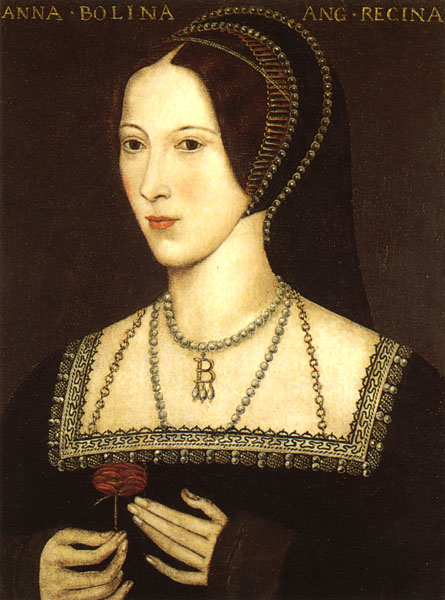
What did Anne Boleyn really look like?

Anne Boleyn, National Portrait Gallery

I am often told that readers are fed up with Tudors.  They know the stories, they’ve heard it all. The need for Tudor novels is over. But the reading public doesn’t seem to believe that. Since I first became an author of historical novels the most recurrent question has been, “Have you written any Tudor books?”

It seems to me that the reading public, both in England and especially overseas, cannot get enough of Henry and his wives. I think the reason for this is not just the glitz and the danger of Henry’s court; it is the many different interpretations we can put upon the stories and the people that inhabit them. There are more explanations for what went on than there are stars in the skies, and there are novelists enough to encompass them all. Added to that of course is that new generations are emerging all the time; a new batch of people who know nothing about the Tudors.

Anne Boleyn remains the number one favourite; the wife that everyone loves to read about. She has been depicted in many different ways; a schemer, a witch, a victim, a whore. She has been demonised by some novelists, and sanctified by others but how close to we ever come to the real Anne? We can never really know the truth about her, we can only piece little snippets together to make up a shadow of the real woman. That is what makes history, and enigmatic figures like Anne, so irresistible. Anne Boleyn was, and still is, a fascinating woman who deserves after all this time a fair reappraisal of her life and death.
  
In his nonfiction book The Life and Death of Anne Boleyn, Eric Ives,  now sadly passed on, reveals a credible figure. He has done the hard work for us, demolishing many of the myths that in the space of several centuries have solidified into fact, and illustrating that what remains is an intelligent, ambitious, but God-fearing woman who happened to win the love of a king.

It is refreshing to discover that perhaps Anne was not a scheming witch with a penchant for sleeping with half the court, (her brother included). Nor was she a woman who gave birth to a monster and plotted the death of the king. Ives’ research reveals someone more sinned against than sinning, and a woman whose mistakes were human ones. Anne was a queen who failed to produce an heir, and a woman who fell foul of the King’s most powerful advisers.  The woman that emerges from Ives’ research is the Anne Boleyn that walks the pages of my novel The Kiss of the Concubine.

To be honest, the real Anne is so obscured by myth and legend that we know much less about her than we think we do. We are not even sure what she looked like. We think of her as dark haired and thin but the familiar portraits we see of her are not contemporary; the originals were lost long ago. Experts disagree, but the oldest 17th century portrait now in the National Portrait Gallery is likely to be a copy of an original, and is favoured by Eric Ives as being the one that comes closest to a real likeness.

There are several written descriptions from her contemporaries and, while none rate her as a great beauty, none remark upon any physical failing either. The fact that she doesn’t emerge as breathtakingly beautiful is refreshing, and illustrates that Henry may have been more taken with the personality within, than with an alluring or fashionable face and figure. 


Brantome, a courtier from France, wrote in his memoirs that Anne Boleyn was ‘the fairest and most bewitching of all the lovely dames of the French court.’ (Weir, p. 151) And Lancelot de Carles stated that she was beautiful with an elegant figure and was ‘so graceful that you would never have taken her for an Englishwoman, but for a Frenchwoman born.’ (Weir, p. 151)

This is praise indeed, perhaps a little too flattering to be true, and many eyewitnesses agree that her looks were unfashionable and not to every one’s taste. As Francesco Sanuto, a Venetian diplomat, illustrates with his description of Anne as  ‘Not one of the handsomest women in the world; she is of middling stature, swarthy complexion, long neck, wide mouth, a bosom not much raised and eyes which are black and beautiful.’ (Ives, p. 40)

It is only after her death that the really detrimental reports begin to emerge. Writing in the reign of Elizabeth I, Catholic supporter, Nicholas Sander, describes Anne as, “rather tall of stature, with black hair and an oval face of sallow complexion, as if troubled with jaundice. She had a projecting tooth under the upper lip, and on her right hand, six fingers.  There was a large wen under her chin, and therefore to hide its ugliness, she wore a high dress covering her throat. In this she was followed by the ladies of the court, who also wore high dresses, having before been in the habit of leaving their necks and the upper portion of their person uncovered.” (Ives. P.39) 

 attributed to John Hoskins [Public domain]

But, although there are common factors when it comes to colouring and bone structure in all these descriptions, I think we can dismiss the idea that she was seriously disfigured in any way. The 16th century was a superstitious time and the characteristics described here all point to witchcraft. It is a clear attempt by Sander to demonise the former queen. Even had the king not been superstitious, I cannot image Henry VIII, who had the pick of the court ladies, finding a woman disfigured in this way to be even remotely attractive, let alone spend seven years of his life trying to get her into his bed. You can read a more in depth look at Anne’s appearance on an earlier blog I wrote for the English Historical Fiction Authors here.


Anne was accused of adultery, incest, high treason, and plotting to kill the King, and she died for those crimes. Yet none of these charges would stand up in a modern day courtroom. Eric Ives states that it can be proved that she was elsewhere on at least twelve of the occasions when she is supposed to have been committing adultery. The only actual ‘confession’ came from her musician Mark Smeaton, who we believe was subjected to torture in the Tower. Although Anne’s sister in law, Jane Rochford, gave evidence against Anne and her husband, George, she later retracted it in February 1542 before she herself faced execution for her involvement with Katherine Howard’s downfall.

While Anne was imprisoned in the Tower, Henry had his marriage to her annulled on the grounds of his former relationship with Anne’s sister, Mary. This made their daughter Elizabeth illegitimate. In truth, this should also have made the charge of adultery invalid, but this was Tudor England when justice was anything but just.

So, those are the bare facts. We can assume Anne was dark, and had attractive eyes and an oval face. We know she was intelligent and witty; even her detractors credit her with that. We know she was pious and refused to be Henry’s mistress, holding out until he promised marriage. That could make her a schemer, but equally it could make her chaste. During her marriage to Henry she tried and failed to produce a son, suffering several miscarriages and providing the king with just one daughter, later to become the greatest queen that has ever lived, Elizabeth. We also know that Anne worked in tandem with Cromwell and others toward church reform, and we also know that at a later stage there was a disagreement between them, and Anne’s downfall followed swiftly after.


Most novels of Anne I have read (but I confess I haven’t read them all) hold Henry alone to blame for Anne’s downfall. They show him as falling out of love with Anne, and place Jane Seymour as the sinister ‘other woman’ whose presence at court and her influence over the fickle king makes Anne’s fall inevitable. There is little evidence to suggest this and perhaps there were other reasons; perhaps another agenda came into play. Perhaps it was politics and not passion that killed her.

In writing The Kiss of the Concubine I have worked closely with the writing of Eric Ives and other prominent Tudor historians to come up with a less clichéd reason as to why Anne Boleyn had to die on that bright May morning in 1536.

The Kiss of the Concubine is now published with Sharpe Books and is available on Kindle and Audible or you can read FREE with Kindle Unlimited. mybook.to/tkoc2

Further reading

Lispcombe, Susannah, 1536: The Year that Changed Henry VIII, 2009.
Fraser, A. The Six Wives of Henry VIII, 1992.
Ives, E. The Life and Death of Anne Boleyn, 2004.
Weir, A. The Six Wives of Henry VIII, 2007.
Weir, A. Mary Boleyn, 2011.
Weir, A. The Lady in the Tower,2009.
Fox, J. Jane Boleyn, 2007.
Denny, J. Anne Boleyn, 2007.

Tuesday, 25 June 2019

Author interview with Walter Gunn


Walter Gunn is the author of the Billy Ruffian's Courier naval espionage series.

Hi Walter, thank you for agreeing to come on my blog. Tell us a little bit about yourself and your background.

For one reason or another, I missed much of my earlier education. Things didn't get much better at the Secondary Modern I attended: it was pretty dire - its only claim to fame was two of its ex pupils discovered a waterless lake in Australia - I kid you not.

I've had my revenge though, in my 'Billy Ruffian's Courier' series, I wrote in some pretty horrible deaths for those teachers I found particularly obnoxious. I saved till last, and most awful, that of the headmaster - this gave much pleasure and, I must say, lasting satisfaction... he should never have caned me!


Which writers inspire you?

There are so many. I live in awe of those past authors who wrote their mss long-hand. But, first and foremost they have to be capable of telling a good story. Names that quickly come to mind are; Dickens, Andy Weir (The Martian), Gabriel Garcia Marquez - A Hundred Years of Solitude and 'Chronical of a Death Foretold', Garrison Keeler for pure entertainment - 'Lake Woebegon Days'. My list could not be complete without Hilary Mantel -'Fludd', 'Every Day is Mother's Day' and of course 'Wolf Hall' and 'Bring up the Bodies'.  Apsley Cherry Garrard's 'Worst Journey in the World' made me feel chilled - now, I find I can only dip into it in the summertime. Then there're Lauried Lee, HE Bates, the list could go on and on... Good God, did I really miss out Jane Austen?


Would you tell us about your latest book?

'No Angels in San Chuan.'

Many years ago before I dreamt of moving to Aragon, we were at a dinner with a hang-gliding friend of ours and she told us of landing high up in the mountains where an old man tottered out of an even older stone barn and thought she was an angel - that charming seed lay dormant for many years.  Later I moved to the Pyrenees and met old men in their mountain huts who could have been him; the seed started to germinate.

  
Where can we buy or see it?

Buy it on Amazon worldwide - print or Kindle - mybook.to/NoAngelsinSanChuan.  And, when I sell the film rights, see it at a cinema near you.


What draws you to a genre?

My fancy at the time. 'Billy Ruffian's Courier' and 'No Angels in San Chuan' are completely different genres. They were both written from a lot of background knowledge and affection. Then there are 'The Snail Cookbook' and 'A Slice of the Pyrenees', again written from experience and affection - I live in a gastronomic area, I cook, and I love food. 'The Hoopoe' is a collection of my short stories. Most of these were ideas I didn't think would stand the strain of being fleshed out as full novels. Though, I am beginning to have second thoughts about this decision - I am being pressured to extend three of them in particular; 'Reverend Selby's Heresy', 'Hawksett & Burroughs' and 'Lucid'.

  
How much research do you do?

Not much really. I check a few dates and facts about the main characters and that's about all.

 When did you decide to become a writer?

I never made the decision, the occupation grew steadily - it crept up on me stealthily. I looked round one day and found I was a writer.  I suppose it really started when I wrote a few articles for international sporting magazines that went down well. I also wrote for corporate newsletters - this was good practice; accountancy firms, aircraft instrument manufacturers, medical equipment design and office furniture. The variety of clients meant swapping genre hats on a daily basis - all good practice for writing the novels I'm now involved with.


Do you write full-time or part-time?

I'm retired so you could say full time - things take so much longer at my age.

 Do you have a special time to write or how is your day structured?

Between 1800 and 2000 every evening - the rest of the time I'm either cooking or thinking about what I'm going to write that evening.
  
Where do your ideas come from?

A good question, and one I've asked myself often. "Where the hell did that come from?" a common outburst when I'm writing. It's a lovely process.


What is the hardest thing about writing?

Trying to get a literary agent and publisher. It's mystifying how I can get completely unsolicited reviews, posts and communcations from people who've read my books, yet agents are just not interested - I guess many 'indi' writers are in a similar position. What is particularly galling is that some of the books that do make it to the market are complete rubbish.
   
What was the hardest thing about writing your latest book?

I didn't find it difficult at all. I simply sat there and it poured out. 'No Angels in San Chuan' takes place in an area I know well. While living there in Spanish Pyrenees in Aragon, I made many friends, heard many tales and fell in love with the mountain people and their way of life. It really wasn't hard.

What is the easiest thing about writing?

Writing from experience and watching what comes out from the end of the pen... I love the way characters will sometimes barge their way into the story and make it easy for me. In'Billy Ruffian's Courier', I introduced a girl called Joss. She was only intended to be a foil for one particular conversation. Post chat. she just refused to leave and is now part of the complete trilogy.
  
Do you ever get writer’s Block?

Only when confronted with Income Tax forms.

For your own reading, do you prefer ebooks or traditional paper/hard back books?

Definitely paperback; there is something special about looking at a book on the shelf and knowing if I open it there is a complete and different world inside: this gives me the sense of other dimensions - other worlds that are real and existing between two covers.

From a commercial point of view, print books are better for marketing. When being read in public - trains, buses ect. people can witness them. This is not possible with ebooks - the author, contents and cover remain anonymous.
  
What book/s are you reading at present?

At the moment I'm not reading anything. I'm involved with writing another in the 'Billy Ruffian's Courier' series - I rarely read other works when I'm head first in my own work. I find it too damn distracting.
  

Thank you Walter Gunn for talking to us today. I hope you will come back soon.
  
Author Profile Walter Gunn

Walter Gunn is the author of the Billy Ruffian’s Courier naval espionage series. During the period the series is set, the author was, like the hero, a Royal Naval marksman, fast launch pilot and sailor.  The backdrop and substance of these books are thus based on his first hand experience.
  
On leaving the Royal Navy, he became a motor racing engineer and constructor; hang glider designer and test pilot - he competed in the 1st World Hang Gliding Championships.
   
Walter was the managing director of a leading edge sports aviation company.  His creation of the extreme sport ‘Speed Gliding’  can be viewed as a natural corollary of his passion for speed and excitement.

He has written for specialist magazines and co-written, designed, researched and produced quality corporate newsletters.  He is a capable photographer - his images have been published by national and international magazines, and his sporting video footage by television.

Walter Gunn has travelled the world extensively both as sailor and as vice president of the Fédération Aéronautique Internationale (FAI) Speed Gliding World Series.  He has lived for more than twelve years in the Pyrenees.  Walter speaks enough French and Spanish to get by.

He has written and published four Novels:  No Angels in San Chuan, Billy Ruffian’s Courier - Part one: Rites of Passage;  Billy Ruffian’s Courier - Part two: Hawkshaw; Billy Ruffian’s Courier - Part three: Baltic Exchange.
  
There is also his book of short stories: The Hoopoe.

His cookery books include: A Slice of the Pyrenees; The Well Thumbed Cookbook and The Snail Cookbook.

He is currently writing Billy Ruffian’s Courier - Part Four: Baltic Exchange.
  
Books by Walter Gunn

The Hoopoe.

No Angels in San Chuan.

Billy Ruffian's Courier - Part one - Rites of Passage.

Billy Ruffian's Courier - Part two - Hawkshaw.

Billy Ruffian's Courier - Part three - Baltic Exchange.

A Slice of the Pyrenees

The Snail Cookbook
  
All titles on Amazon