Wednesday, 4 May 2016

The Joy of Book Fairs

Christoph Fischer and Me 
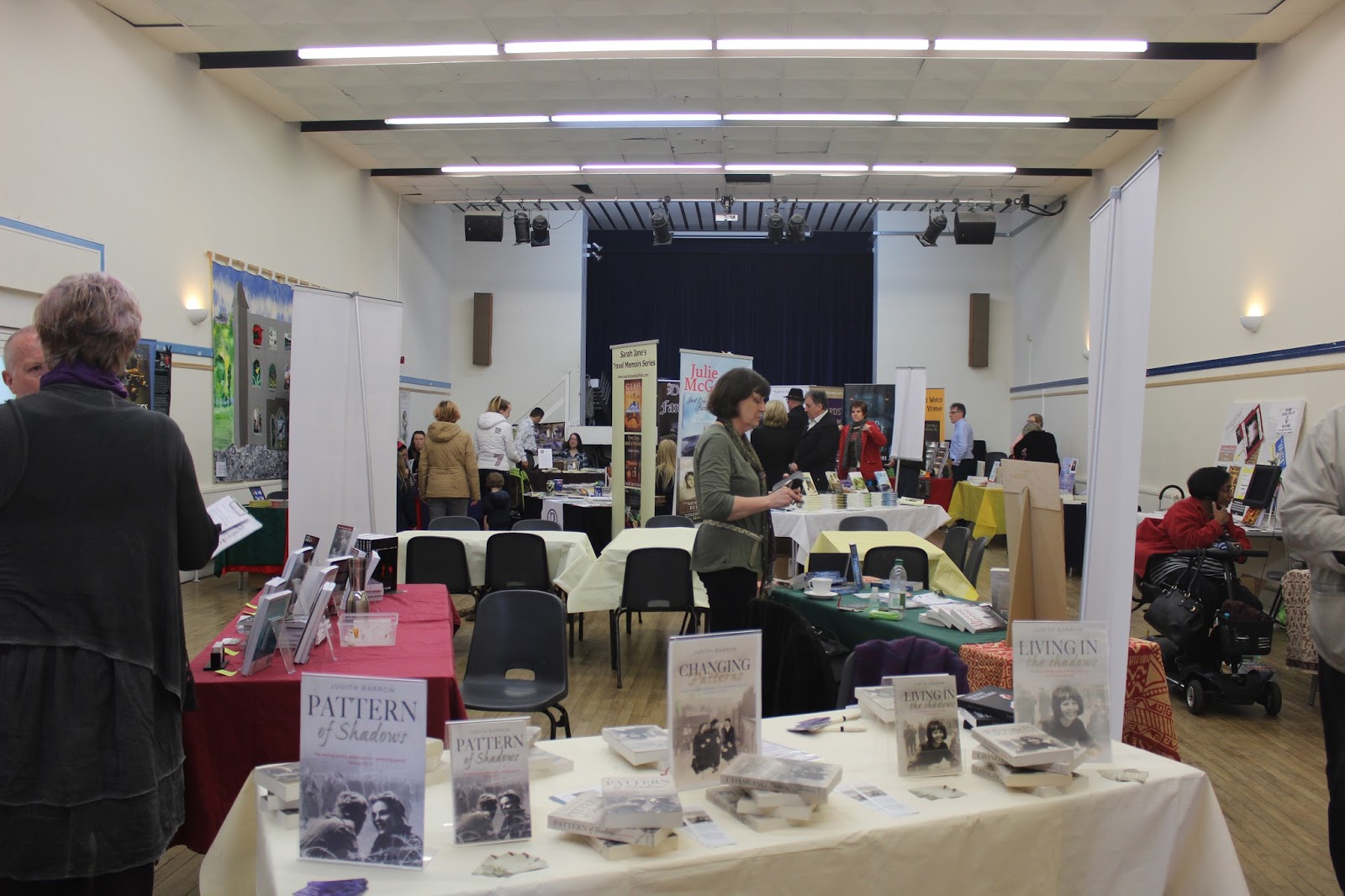
I attended my first book fair on Saturday. I have been to Christmas Fairs before and I attend Raglan Castle’s annual Tudor Weekend in the summer where I sell lots of books and meet readers and re-enactors but this was my first proper venture into the world of Book Fairs.
I am a very shy person. I thought I might feel like an amateur. I thought it might be ‘clicky’ or my elaborate Tudor style table layout wouldn’t be appropriate for this type of event. Happily, I was wrong. It was a lovely day.

I had only met two of the other authors previously, and a handful were as yet unseen Facebook contacts; the rest were strangers. I don’t usually like strangers. But now, after Saturday’s book fair, they are friends. More than one confessed to also being nervous and uncertain of what was expected, and this sharing of confidence made me realise that other authors are nothing to be afraid of. They are just ordinary people with stories to share.

We were all brought together by the tireless efforts of Christoph Fischer, a prolific author himself, who provides unflagging support of his fellows. The moment we arrived and began to set up our tables a sort of camaraderie emerged. We helped carry boxes, borrowed tablecloths, admired one another’s posters, peeped between the covers of each other’s books. With so much in common, I knew right away it was going to be a good day.

There were talks. I kicked off with a talk about Tudor portraits. After having made comprehensive prompt notes to help me along, I then forgot my reading glasses and couldn’t read a word. I need not have worried. I realised I would just have to ‘wing it’ and the audience was patient and brilliantly supportive. They offered up intelligent, interesting questions for me to answer about the Tudors. In fact, in the end we ran over the allotted time and some of them joined me at my book table afterwards to continue the discussion.

There were workshops from Judith Barrow (author of the Patterns Trilogy) and Sharon Tregenza who writes children’s fiction. Wendy Steele, author of what she describes as 'fantasy with a dollop of magic,' gave a talk on Fantasy and Magical Realism. Carol Lovekin read from her new release Ghostbird, and Julie McGowan read from Don’t Pass Me By. I was delighted to meet Thorne Moore, whose atmospheric books I really enjoy. At the table near mine was Rebecca Bryn. The evening before I’d started reading her book, The Silence of the Stones, although I’d no idea she would be attending.

There were many, many more authors present, too many to mention in detail but the fair provided something for everyone, all literary tastes catered for.


A steady stream of visitors kept the day interesting. I had many stimulating conversations, gained some news readers and met readers who have been following me since my early days. For me, the most thrilling person to come to my stall and buy my books was a young girl. I don’t know her name but she was no more than twelve, and she reminded me of myself at that age. When her mother handed her the books she purchased, she clutched them to her chest and spoke shyly but with great passion of her love of history. It is always nice to meet a kindred spirit. I told her I’d begun writing when I was her age and hope she went away encouraged to begin to write her own.


To boost our flagging energy local food outlet Iechyd da kept us topped up with tea and coffee and some rather delicious cake. We could not have done without them.


This morning I learned that the Llandeilo Book Fair was so successful, another has been booked for 10th December 2016 – hope to see you there.


Tuesday, 15 March 2016

The life of Margaret Beaufort

Margaret Beaufort in often depicted both in fiction and non-fiction as manipulative, duplicitous, vindictive, sometimes a little mad. In my own book, A Song of Sixpence, she appears in her latter years, an unwelcome mother-in-law in the marriage between Elizabeth of York and Henry VII. Writing from Elizabeth's perspective, Margaret at first appears hardened, unfriendly but as their relationship continues, and Elizabeth produces a string of heirs for the king, Margaret softens, just a little, and their friendship develops. Ultimately, as she has at many deathbeds during her life, Margaret weeps copious tears at her daughter-in-law's demise. 

I could have written her all sweetness and light but I don't believe she was like that. My research shows a woman who lived an incredibly hard life, and difficult lives take their toll. She would have had trust issues, perhaps she learned self-containment was the best policy but Margaret's cool exterior shields a warm and vulnerable heart. Margaret was a good woman; a virtuous, generous soul whose determination to get her son on the throne took guts and strength. 

Women who live such lives often don't have time for niceties, in my experience they can be efficient to the point of rudeness. Margaret would not be one to suffer fools gladly, or tolerate nonsense. Once Henry was on the throne her vast experience and level head enabled her to offer wise and solid advice. She gave freely to charity, endowed universities and hospitals and encouraged theological study. All these characteristics are positives yet she is consistently depicted in the negative, that is, if we believe serious, pious, pro-active, politically motivated women to be negative.

Margaret was no beauty, she was not a simpering, pathetic princess and is therefore difficult to slot into a fictional stereotype. She enters A Song of Sixpence toward the end of her story. She has achieved her ambitions, her goal to put her son, her blood on the throne of England has been realised. Henry has overcome all opposition, the royal nursery is full of children. She is elderly, and as the king's mother afforded the honour of a queen. The key words for the latter part of her life story are : success, triumph, honour. But what about her beginnings?

An excerpt from The Beaufort Bride:

The Lady Margaret

Bletsoe Castle 1449

It is a wild night. Outside, the trees are blackened by rain. They thrash their limbs in a dance of anguish, shedding leaves and twigs across the lawn, but here, at the nursery window, I am safe and dry. I press my hot cheek against cool thick glass and peer into the darkness of the garden.
The shrubs and hedges assume threatening shapes; the yew tree by the gatehouse is a hump of deep black menace. My seven-year-old mind forgets the times my stepsisters and I have happily played there on the green mead in the sunshine; tonight I see only threats, only danger, only demons.
A fistful of raindrops spatters against the window and I draw back with a gasp as a yellow leaf, as large as my face, smacks suddenly onto the glass. I stare at it, stuck there like a hand held up in warning. Do not look, Margaret!
But I do look. I cannot help it. If there is a beast in the garden, I have to see it. I have to witness the moment it leaps from the darkness.
Ever since I can remember the grown-ups have kept secrets from me. I didn’t know my mother had been married before, that my siblings had a different father to mine. It was Oliver who told me, and ever since he has delighted in revealing other, more horrible things. Now, to deny him pleasure, I am determined to learn secrets for myself. Secrets that are sometimes best left undiscovered.

No one tells me when I am made a ward of the Duke of Suffolk, fated to marry whomever he pleases. It is Oliver who breaks the news and, at first, I don’t believe him.
“Don’t be silly,” I scowl. “Stop teasing.”
“Oh, I’m not teasing.”
He slides from his seat and comes skulking toward me, his head thrust forward, a grin of mischief smeared across his dirty face. “You have to do as he says and go happily to your marriage, even if he weds you to a grandfather who will beat you twice daily.”
“He wouldn’t do that.”
I can hear the doubt in my own voice and it spurs him on to greater revelations.
“He can do with you as he wishes and you have to obey him or, if you don’t, you’ll be shut up in the Tower as your father would have been if he hadn’t -”
 A sudden movement and Edith comes to stand beside me. She places her hand on my arm.
“Oliver, be quiet. You are being cruel. Don’t listen to him, Margaret, just ignore him. Why don’t you come and help me sort colours for the tapestry I am planning?”
Edith, my older and favourite sister, grabs my wrist and tries to tug me toward her chair but, drawn to the awfulness of Oliver’s secret, I pull away.
“What do you mean, Oliver? My father in the Tower; what do you mean?”
He stands tall, runs two fingers across his upper lip, presenting a sudden image of how he will look when he is a man with a fine moustache and beard. His head is back and he squints down his long nose with a smirk. He is no longer a companion of the nursery; he is an accuser, a torturer, a devil with wickedness upon his lips.
“Your father was a traitor, waiting to be sent to the Tower. The king was going to chop off his head … but your father sliced his own wrists before he could be taken.”
With a gasp of horror, my stepsisters look up from the hearth where they are sewing. Everyone is looking at me. My cheeks begin to burn. I can feel their eyes boring into me, waiting for my reaction. I cannot move; my ears are ringing. It is as if he has struck me but I manage to raise my chin and clench my lips across my teeth.
Oliver watches my struggle for composure, but his venom is subsiding. He is clearly calculating our mother’s reaction should I run to her with the tale of his sins.
It takes a great deal of effort to shrug my shoulders and turn away as if nothing is amiss. His uncertain laughter follows my stiff-legged journey toward the door. I reach for the latch but before I pass through it, I feel Edith’s hand on my shoulder.
“Margaret, don’t believe him. He heard it from the servants – it is likely just tittle-tattle.”
I look into her kind eyes and read the lie hidden there. She seeks to spare my hurt, but I can tell she believes the story. I try to smile but my mouth goes out of shape, my chin trembling. She places a gentle hand on my coif but I shake it off, cuff away the first tear before it has a chance to drip onto my cheek.

I find Mother just returned from chapel. She halts when she sees me and hands her prayer book to one of her women.
“Margaret? What is the matter? Are you ill?”
I shake my head and perform a wobbly curtsey.
“No Mother, I am well.”
She sits down and beckons me closer, places a hand beneath my chin. She feels my brow for signs of fever, pulls down my lower eye lid and bids me stick out my tongue. I obey, passively waiting while she examines my teeth and looks in my ears.
“You are very pale, and you are trembling. What has happened? Have you been fighting again?”
“No, Mother.” Although I threaten to, I never bear tales of Oliver’s taunting. I search around in my head for a small lie that will explain how I have heard the rumour of my father’s disgrace. “I heard someone talking.”
She sits back, links her fingers and rests her hands on her stomach.
“You should never heed gossip, Margaret.”
“No, I don’t but … they said bad things about my father.”
I watch her face blanch and know without her confirmation that Oliver’s tale is true. Her face squirms unattractively as she tries to school her features into obedience.
“Who have you been listening to?”
“Oh … I – I don’t know. We were playing hide-come-seek and I was hiding in a cupboard when some servants were passing … I couldn’t see who it was.”
I will have to make confession and do penance for such a lie, but I refuse to bear tales. It will only make Oliver resent me more.
“Is it true, Mother?” I step closer. “Was my father a bad man? Did he ... did he …?”
I cannot form the last words and as my fear spills from my eyes, her own composure dissolves. She fumbles for a kerchief, blows her nose.
“Oh, Margaret.” She screws the square of linen into a ball and looks at the ceiling. “Your father was a good man, an honest man but … well, he was not always wise. He made mistakes in France and angered the king. When King Henry refused him an audience, your father fell into despair. I … we are not sure what happened … it was a long time ago, six years.”
I listen to the horrid truth, counting back the years on my fingers. 1443, the year I was born.
“So, if my father was a traitor, are we all disgraced? Am I a disgrace? Am I, Mother?”
She sighs, casts about for her kerchief again and dabs her nose.
“No. Your great uncle, the Cardinal, and your uncle Edmund will ensure we remain in the king’s good graces. You must learn that everything is not black and white, or good and evil. There are many different shades. Your father was neither; he was just a man, and all men make mistakes … even kings.”
The end of her sentence is barely audible. I jerk my head and stare into her eyes, trying to fathom what she means. I have been taught an anointed king is sacrosanct. It has never occurred to me that kings can err.
“So the king was wrong?”
“Mistaken, perhaps, is a better word; an error of judgement.”
“What about us? Is Oliv - are the servants right when they say that I must marry whomever the Duke says?”
She looks around the room, her lashes fluttering like damp butterflies that cannot decide upon which blossom to settle.
“We must all marry where we can, Margaret. A woman is seldom given choice.”
“But what if he picks an old man who will beat me twice a day?”
The words are out before I can stop them, Oliver’s laughter echoing again in my ears. She pauses with the kerchief just below her nose.
“No! Where do you get such ideas, child? Come here.”
I long to slide onto the chair beside her and inhale her sweet herby scent that speaks of security. I wish I could snuggle to her bosom. If she was not big with child I could crawl into her lap as if I were a baby. She places her hand upon her swollen belly. “I suppose it is time I told you of your future. You are an important asset to the Duke but he has chosen very carefully for you.”
“Who will want to marry me when my father was so bad?”
She laughs musically, tilting her head back. “Oh my dear child, do you not realise how rich you are? You are an heiress and will be an asset to any husband. Men have already been seeking the honour of your hand.”
I digest this news slowly. So, Oliver was right. I am to be sold.
“You said ‘chosen’ so the Duke has already decided?”
Her hand, that has been gently rubbing the place where her unborn child is curled, stops suddenly. She smiles and looks down at it. She has felt the child kick – another half-sibling. I will no longer be the smallest. I will no longer be the baby of the family. I pray this child will be kinder than Oliver.
“The Duke fancies you for his son, John, who is destined to be a great man.”
I have seen the Duke of Suffolk many times, the great William de la Pole who has fought so long for the king in France. Oliver says that he has almost single-handedly kept our territories in English hands. He is a favourite of the king, but the populace dislike him and have christened him ‘Jackanapes.’
The duke is a big man, large and rough. I remember when I was little, hiding behind my mother’s chair when he came into her parlour. His giant frame blocked the sun from the window and his laugh made the wine cups rattle on their tray. I am filled with dread that his son will be the same.
“Suppose I do not like him?” I whisper with sickness washing in my belly. Mother smiles and closes one eye before answering conspiratorially.
“Then you will make the best of him, as do all women in our position.”

***

I am happy to announce that Book One of The Beaufort Chronicles: The Beaufort Bride tracks Margaret's life from her beginnings at her mother's house, Bletsoe Castle, through her life in Wales and the trials of her marriage to Edmund Tudor, her widowhood, the birth of Henry and her betrothal to Henry Stafford.

Book Two: The Beaufort Woman illustrates Margaret's development from a child into a young woman. It traces her journey through the wars of the roses, her second widowhood, her marriage to Stanley, and her political manoeuvres through the complexities of the conflict between York and Lancaster. She does not rest until the attainment of her dreams at Bosworth field.

Coming soon in 2016


Book Three details the reign of Henry VII and her role as The King's Mother in establishing, once and for all, the Tudor dynasty.

Book One: The Beaufort Bride . Click here to purchase your copy.


Judith Arnopp is the author of eight historical novels of the Tudor and Medieval period. She also blogs and offers talks on Tudor history. You can visit her webpage for more articles and information

Photographs from Wikimediacommons or author's property.

Monday, 29 February 2016

Sudeley Castle and Katherine Parr

As the spring approaches and we all begin to think about day trips and picnics I thought I'd reblog this piece I wrote about Sudeley.

 Sudeley Castle is a comparatively small place in the scheme of things, set against the backdrop of the Cotswolds. Sudeley is, and has been, many things; today it is a family home, a beautiful garden, a historic jewel, and the last resting place of an English queen. The Castle is steeped in history and was first mentioned in a 10th century charter. King Ethelred hunted deer in the park and later, when the castle passed to Goda, her distant relationship to William the Conqueror, saved it from Norman take over.

Sudeley remained in the hands of Goda’s family until the reign of Henry V when the castle was gifted to Thomas Boteler in way of repayment for his action in the war with France. It was Boteler who began to transform Sudeley into an enviable home, enlarging and updating the existing fabric of the building to create a place fit for royalty.

When the Lancastrians were defeated and Edward IV took the throne the Boteler family were forced out and Sudeley’s new owner was no other than the king’s brother, Richard of Gloucester, later King Richard III of car park fame.

When the tables turned again and Richard was defeated at Bosworth, Henry VII took it over, bestowing it on his loyal uncle Jasper Tudor. After Jasper’s death Sudeley once more became crown property.

Henry VIII visited once with Anne Boleyn. They met with Thomas Cromwell there to discuss the reformation of the monasteries and took a keen interest in the Blood of Christ housed at nearby Winchcombe Abbey. At this time the castle was run down and unoccupied for much of the time.

On his accession to the throne Edward VI made his uncle, Thomas Seymour, Lord of Sudeley and after his marriage to Katheryn Parr, Seymour and his new wife made their home there.
 The Seymours implemented many improvements and Katheryn took great care in choosing the décor of the nursery for their expected child. Unfortunately, to Thomas Seymour’s sorrow, Katheryn died scarcely a year later, having given birth to a healthy daughter, whom they named Mary.

With Thomas’ ward, Lady Jane Grey, acting chief mourner Katheryn was laid to rest in St Mary’s church adjacent to the castle. Today visitors to Sudeley can view a love letter and portrait gifted to the queen by her husband.

Katheryn’s step daughter and friend, Elizabeth Tudor, later Queen Elizabeth I, visited Sudelely on three occasions during her reign. It is easy to imagine her walking in the garden, remembering her stepmother, recalling conversations, small personal details of their shared life that are now lost to history.
Sudeley’s history doesn’t stop with the Tudors. During the civil war Prince Rupert made the castle his headquarters, and Charles I stayed there for a time during the campaign to take Gloucester.

During the course of the war Sudelely passed back and forth between Royalist and Parliamentarian hands until Parliament ordered the ‘slighting’ of Sudeley making the house indefensible. The roof was removed, and the rest of the building fell swiftly into decay. The fine worked stone was quarried by locals until the grand castle became nothing more than an attractive romantic ruin. For the next two hundred years it was left to the mercy of the elements, a trysting place for lovers, or a hideaway for thieves.

In 1782, Katheryn Parr’s grave was rediscovered. The lead casket was opened the body found within reported to be 'uncorrupted'. She was reinterred in 1817 by the Rector of Sudeley and a plaque copied from the original inscription on the lead coffin placed upon it. Today there is an effigy on the tomb but this was made in Victorian times.

Sudeley remained in elegant decay until the nineteenth century when it was bought by two brothers, John and William Dent, who embarked upon a restoration project. They employed architect Sir Gilbert Scott to restore the chapel. The walls and large parts of the castle were restored. Finally Lady Emma Dent spent almost fifty years putting the finishing touches, filling Sudeley with fine art and historical artefacts.

Yet, of all the people mentioned in this potted history; the Lords, the ladies, the kings, the politicians; it is Katheryn’s memory that lingers. Visitors flock there, not just to see a splendid house and a magnificent garden; they go there because of Henry VIII’s last queen, Katheryn Parr.

The Tudor style parterre is only a reconstruction but, although Katheryn may have gone it is easy to imagine her there, inhaling the scent of the flowers, the kiss of summer rain on blush pink petals.

While you move quietly between the roses, or pass through the old yew hedge, you can imagine a footstep on the gravel behind you, the sweeping red skirts of her kirtle as she joins you. And as she follows you around the flowerbeds, you may feel the brush of her hanging sleeves.

Judith is the author of seven historical novels and is currently working on a trilogy tracing the life of Margaret Beaufort. Book one of The Beaufort Chronicles, The Beaufort Bride will be out soon.


For more information about Judith's work please click here

Pictures of Sudeley Castle and of the church at the castle are both licensed under the Creative Commons Attribution 2.0 Generic license, the former to Gordon Robertson, the latter to Jason Ballard.  The picture of Katheryn Parr's tomb is licensed to TudorQueen6 via the Creative Commons Attribution-Share Alike 3.0 Unported license.  The portraits of Thomas Seymour and Katheryn Parr are in the public domain due to expiration of copyright.

Sunday, 7 February 2016

The Plight of Picard

My blog today is very different to the ones I usually write. No mention of history or books but my post today concerns something even closer to my heart.

This is Picard in his younger days. He is a Welsh Mountain Pony, the most well-mannered little man you could wish to meet, which is surprising considering his history.

We first met Picard when he was a foal. We were at a horse sale in West Wales, buying buckets and lead ropes for the ponies at home. We were horrified when a large over-crowded livestock lorry turned up and men with large sticks began driving yearlings from the back. They were terrified. It was a horrible sight, the sort that makes you shamed to be human. Every year the surplus wild ponies are rounded up on the mountain, they are squeezed into trucks and sold for silly prices at sales around the country. The low prices often mean they are bought on impulse, go to unknowledgable homes, or end up as fodder for the meat man, shipped to Europe for the horse meat industry. It seems a sorry waste of life for these beautiful ponies to end up as dog meat.

Needless to say, when it was Picard’s turn to be hounded into the sale ring, frightened with whips to make him prance and show off his good points, he was the last of a very long queue. The few people who had come in search of a cheap pony to rehome had already bid, their pockets were empty and the only person (I use the term lightly) bidding on Picard was the meat man. The meat man never bids high so I took my hands from my pocket and decided to take this wide eyed, terrified baby home.

My daughter already had a Shetland she was growing out of so I thought maybe Picard would turn out to be a good second pony. I won him with a £12 bid – a muddy, dark grey pony with burs in his coat and terror in his eye. He didn’t want to get in the truck; there was no way to load him without scaring him even more but with great difficulty we managed to get him safely home. 

He trembled in the corner of his stable for days, freaking out each time we went in to change his water and replenish his hay. The burrs and mud had to remain in his coat while I sat on a bucket with my back to him and sung nursery rhymes and lullabies so he'd become accustomed to my voice and presence. This went on for days and still he wouldn’t look at me. Each time I turned round he stuck his nose in the corner and put his head down. He was so unhappy in those early days but eventually we noticed a change. He no longer tried to scale the stable wall when we went in; he began to trust the bucket and snatch a little hay from the rack.

When he was ready to emerge from the stable his first friend was Rudolph, the Shetland, his second was Jazz, another Welsh Mountain Pony, and Cynon the cob cross. His time was spent with them in the field where he could gallop about, kicking his heels, happy in their company. It was a brilliant thing to see.


Whenever we rode or groomed the other ponies, Picard watched from a distance, ready to flee if we so much as took one step toward him. But, slowly, he came to realise we were never going to wallop him over the head with a pole, or force him to do anything he wasn’t happy with. Little by little he grew calmer, we were allowed to brush him, we could lift his feet one by one, scratch his hind quarters but never his head. He remains head shy to this day and getting a head collar on was a nightmare but by degrees, we managed it. My eight year old daughter could lead him around, sit on his back, tack him up but he was never really happy with it and we could only progress so far. After a year or so, we desisted but he remained with us, a companion to our other ponies.

That was twenty years ago, hopefully things have changed for ponies like Picard but I don’t think they have. There are far too many greedy, unkind human beings and too many unwanted ponies. One by one our ponies died of old age and now Picard is the only one remaining.


Age is catching up with my husband and I now. Our children have left home and, due to health issues, we have had to give up our beloved smallholding. We sold it at the end of last year and the new owners kindly allowed Picard to stay until the new home we had sorted for him was ready. He was due to move to a lovely home next week but to my horror that has now fallen through and the new people who now live in the lovely smallholding want him moved.

So this blog is a plea for a good forever home for a much beloved veteran who requires gentle handling and understanding. He lives out all year round, survives on air and doesn’t require lush grazing. Picard is very gentle. He has never kicked or bitten and will follow you to the moon if you wave a bucket under his nose and he is good with the farrier. We are happy to help with his costs and essential veterinary care. Most of all we want the last years of his life to be as happy as the last twenty. He needs a safe, secure, caring home, preferably with other horses.

If anyone can help or knows someone else who might please contact me on silentwhisper1@aol.com or message me on facebook. Please share this blog widely so that we might find reach a good Samaritan.

Thank you for listening.

Thursday, 28 January 2016

Karen Aminadra and bad boy Mr Wickham

If you've missed Karen Aminadra as much as I have you will be delighted to hear she is back. I am thrilled to have her on my blog this morning to tell us what she has been doing, and thankfully, it seems she has been writing. Go ahead, Karen, tell us all about it.

In 2012 I wrote my first book, Charlotte, the first in my Pride & Prejudice Continues Series. After Charlotte, came Rosings, and then my latest, Wickham.

Wickham was such a challenge to write. George Wickham is not your run-of-the-mill Jane Austen character, is he? He’s a rogue. And, love him or hate him, he was my next target along with his rather silly wife, Lydia. I toyed many times with reforming him, I toyed with straightening Lydia out and forcing my will as the author upon them, but characters like Wickham and Lydia have a will all of their own.  Add into the mix the fact that George Wickham is a Lieutenant in the British Army during the time of the Napoléonic Wars and you have all the ingredients for some explosive story-telling.


Here is a little taster to whet your appetites… 

Lieutenant George Wickham shivered. He was freezing sitting on the damp grass, but that discomfort was nothing compared to the pain in his wrists where the cold, hard iron from the manacles dug into his flesh. He tried to shift position to ease his pain, but with every movement, some other part of his body hurt. Sighing he gave up. He lolled his head back against the stake in the ground he was chained to. It serves me right. I do not deserve comfort.
A shuffling on the ground behind him and the touch of a gentle hand against his, reminded him sharply of his beautiful companion. It was entirely his fault that she now found herself chained and shackled beside him. Whatever her fate was to be—whether free or imprisoned, alive or dead, it was all his doing.
He closed his eyes and wished to God that he had been a steadier man, not prone to the whims of fancy. He wished he could think straight when his heart fluttered at the sight of womanly beauty; yet, he was no such man. He was a libertine and a blackguard, and his insatiable desires were the reason he found himself in his current predicament.
His thoughts returned to six months ago, to England, to where this whole regretful misadventure began…

Whatever will happen?  That’s up to you, of course, to find out.  I really enjoyed writing this book. Wickham took me to places I never thought I’d go and doing things I never thought I’d do.  But then, you’d expect that of George Wickham, wouldn’t you?


Wickham is the third in the series. You can check out the others on my website www.karenaminadra.com or through Amazon. Here


Wickham ~ Pride & Prejudice Continues, Book 3.

Wickham believes life is cruel to him until he comes face-to-face with an irresistible pair of dark brown glinting eyes and falls in love.
He is bored with his lot in life. His wife, Lydia, drives him as mad as a hornet’s nest, and he does not give her the attention and respect she demands.
They both yearn for change.
When Wickham leaves England to fight against Napoléon’s army in France, they both get their chance.
However, what they want is dangerous, foolhardy, and could wind up killing Wickham and ruining Lydia’s reputation forever.
Lydia’s wicked neglect of their infant son in favour of her own desires and need for attention could lead her into very hot water.
Wickham’s desire for the Frenchwoman he yearns for could be his complete undoing.

Wednesday, 7 October 2015

Edmund Tudor: Father of the Tudor Dynasty


https://upload.wikimedia.org/wikipedia/commons/5/5a/Armoiries_Edmond_Tudor.png


My latest book, The Beaufort Bride follows the early years of Margaret Beaufort, mother to Henry VII. It is the first in a trilogy The Beaufort Chronicles. Book Two: The Beaufort Woman will be available later on in 2016. Today I am looking at Margaret's husband and father of her only son.

Edmund Tudor is best known as the father of Henry VII. His death in November 1456 at Carmarthen at the age of twenty-five means his presence on the historical record is scant. While his brother Jasper went on to play a leading role in the Wars of the Roses, Edmund passed into shadow. In most academic books he is mentioned briefly, often scathingly, but although short, his life was vital to British history. 

Edmund was the eldest son of Owen Tudor and Katherine de Valois, widow of Henry V. Katherine was rich and powerful, and a very desirable prize. The Protector, Humphrey of Gloucester disliked an attraction she formed for  the ambitious Edmund Beaufort and,  in 1427-28 an act was passed in parliament preventing Katherine from marrying without the consent of her son, the six year old King Henry VI. Even the king’s consent could not be given until he reached his majority; a clever move by parliament to disempower a prominent woman. Owen, a groom in Katherine’s household is a surprising choice for a woman of her status and there have been many theories to explain it. Perhaps the union between Owen and the queen dowager was a love match, perhaps not. There are suggestions that Edmund was in fact the bastard child of Edmund Beaufort and Tudor stepped in to save her reputation when marriage to Beaufort was denied but there is nothing to substantiate that claim. That particular subject requires a whole new blog and luckily there is a fabulous article by Susan Higginbotham about it here
Marriage of Katherine de Valois and Henry V https://upload.wikimedia.org/wikipedia/commons/2/2a/Marriage_of_henry_and_Catherine.jpg
There is no existing record of a marriage taking place between Owen and Katherine and many think that, if they married at all, they did so in secret making their offspring the illegitimate issue of a common law marriage. Their first child, Edmund, was born in June 1431, followed by perhaps six others but only Edmund and Jasper had any prominent role in history.
After Katherine’s death in 1437 Edmund and Jasper were given to Catherine de la Pole, the abbess of Barking who brought them to the attention of their half-brother, Henry VI. After their education was complete Henry kept Edmund at court, knighting him in 1449 and creating him Earl of Richmond in 1452. In 1453 Edmund was made legitimate and endowed with large grants and property; he was also given the wardship of the heiress, Margaret Beaufort. In 1455 they were married at Margaret’s mother’s home, Bletsoe Castle. Margaret was twelve years old.

Shortly afterwards Edmund was sent by the king to Wales to quell unrest there. At first they stayed at Caldicot, where Margaret was to become pregnant, then moved to Lamphey Palace which Edmund used as his power base. Conflict with the Duke of York’s henchman, William Herbert, led to Edmund’s capture and imprisonment at Carmarthen castle where he died either from wounds inflicted in battle, or from some infection contracted during his interment. Margaret, now just thirteen and well advanced in pregnancy, turned to her brother-in-law, Jasper, for protection and fled to Pembroke castle where she gave birth to a son.
 
Pembroke castle, birthplace of Henry VII

There was nothing unusual in a girl marrying so young but in most instances consummation was postponed until the girl had matured. Edmund however, did not wait and Margaret fell pregnant straight away. There may have been a few contemporary raised eyebrows but there was no undue outrage, and Margaret was not alone. In 1350 Bianca of Savoy was married at thirteen and gave birth a year later, and in 1493, aged thirteen, Lucrezia Borgia married her first husband and bore a child within a few years. Of course, although records show that many more girls who married young didn’t give birth until they'd been married a few years this does not necessarily prove that consummation did not take place. We should perhaps consider if they were physically able to pro-create. Child birth is not an immediate evidence of consummation having taken place, it is often delayed. We should not be too quick to judge. 
Margaret was as ambitious as her contemporaries, she may have considered herself lucky to have secured a relatively young and powerful husband. She was a cousin of the king, married to a beloved brother of the king. She could have done a lot worse. Had Edmund survived the outcome of the wars of the roses may have been very different and Margaret in a very good position.

I am not in any way condoning sex with young girls but we must not forget that the medieval mind set was vastly different to ours. When a young girl married it was seen as her taking her place in the adult world and celebrated as such. It is unlikely Margaret would have been expecting romance from marriage. She would not have been ignorant of the facts of life for there was little marital privacy in the medieval world. Marriages were celebrated by ‘bedding’; a custom when the wedding party accompanied the newly-weds to their chamber to witness them being put naked to bed. It was an occasion for ribaldry and jest, often a drunken finale to the wedding feast.
 
Margaret Tudor: Granddaughter of Margaret Beaufort https://upload.wikimedia.org/wikipedia/commons/8/80/Margaret_Tudor_-_Daniel_Mytens_-_1620-38.jpg
In many books, both fiction and non-fiction, the union of Margaret and Edmund is described in horrified tones. Elizabeth Norton in her book Margaret Beaufort: Mother of the Tudor Dynasty, says the ‘marriage shows an unpleasant side of Edmund Tudor’s character, and it is clear that he was acquisitive to the point of disregarding his young wife’s health and well-being.’
Jones and Underwood in The King’s Mother describe the event as follows: ‘Edmund quickly made his twelve year old wife pregnant, his wish to secure a life interest in her estates taking priority over any concern for her safety and well-being.’

Margaret’s intervention in later life during the arrangements for her granddaughter and namesake, Margaret Tudor's marriage to the King of Scotland, is often taken as evidence that she regretted her own early union with Edmund. In ensuring that a clause was worked into the marriage treaty that consummation would not take place until her granddaughter was of age merely indicates Margaret regretted the unforeseen damage done by childbirth, not that she regretted her relationship with Edmund.
 
Margaret Tudor: grandaughter of Margaret Beaufort https://upload.wikimedia.org/wikipedia/commons/8/80/Margaret_Tudor_-_Daniel_Mytens_-_1620-38.jpg
Some novelists have taken Margaret's early deflowering and run with it, several novels describe lurid wedding night scenes involving abuse and rape. It may very well be true that greed was at the root of Edmund’s decision not to wait to consummate the marriage but that doesn't make him a monster. I prefer to consider other possible explanations.

Until a marriage was consummated it was easily annulled, co-habitation provided a form of protection to the couple. Margaret was a great marital prize in a time of political unrest, her position so close to an unstable crown made her valuable, not just to Edmund. 

I am not sure why modern day readers (and authors) relish the idea of violence. It does not automatically follow that early consummation meant she was subjected to any form of force. She wouldn’t be the first twelve year old to have formed romantic feelings for an older man. There is nothing else to suggest Edmund was anything other than a good, attractive man. Perhaps she was willing; perhaps she was gently wooed and seduced. 
Edmund Tudor's tomb photo by Judith Arnopp

In her later life there is no evidence that Margaret ever spoke critically of Edmund; some sources suggest she requested to be buried with him, a request that was denied for she lies at Westminster close to her son. Edmund Tudor may have taken Margaret's virginity at a young age, his action may well have made it impossible for her to conceive or carry another child but, in doing so, he gave her the very thing she most cherished; her son, Henry, the future Henry VII. A son to whose cause she was to dedicate the remainder of her life; a son who, despite two further marriages, was to remain the love and the focus of her very remarkable life. 
If Margaret held no resentment toward Edmund, why should we?

Coming soon


Pembroke castle photo by Judith Arnopp
Photographs from Wikimedia Commons

Further Reading
Elizabeth Norton, Margaret Beaufort; the King’s mother
Debra Bayani, Jasper Tudor, godfather of the Tudor dynasty
Jones, M.K. & Underwood, M. G The King’s Mother
Skidmore, C. The Rise of the Tudor Dynasty
Susan Higginbotham, Arms and the Man: Was Edmund Tudor illegitimate click to read


Judith Arnopp is the author of seven historical fiction novels set in the medieval and Tudor period. She is currently working on Book two of The Beaufort Chronicles: the life of Margaret Beaufort. To read excerpts and customer reviews please visit:
Her webpage: www.juditharnopp.com