Showing posts with label authors. Show all posts

Wednesday, 4 May 2016

The Joy of Book Fairs

Christoph Fischer and Me 
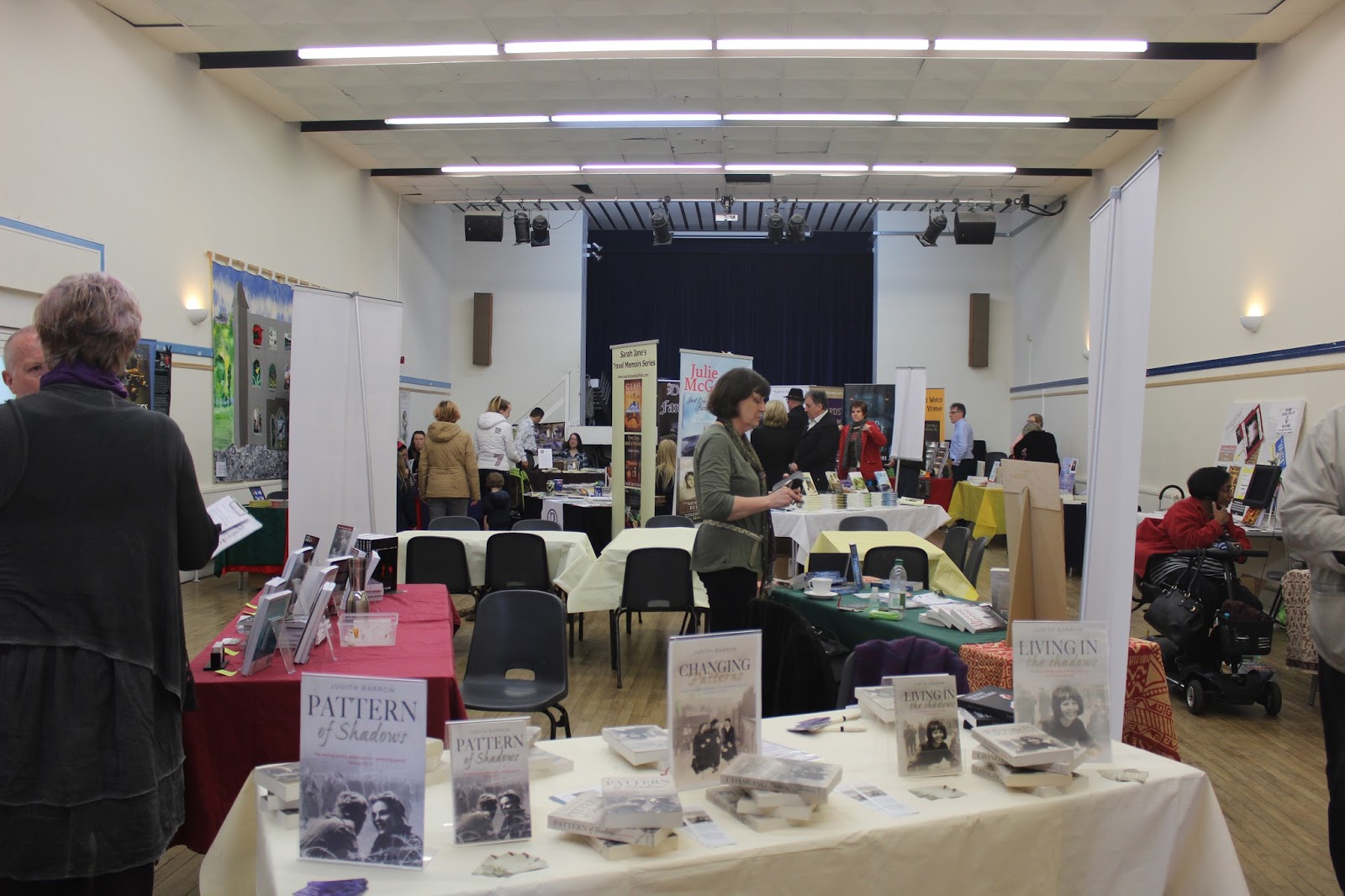
I attended my first book fair on Saturday. I have been to Christmas Fairs before and I attend Raglan Castle’s annual Tudor Weekend in the summer where I sell lots of books and meet readers and re-enactors but this was my first proper venture into the world of Book Fairs.
I am a very shy person. I thought I might feel like an amateur. I thought it might be ‘clicky’ or my elaborate Tudor style table layout wouldn’t be appropriate for this type of event. Happily, I was wrong. It was a lovely day.

I had only met two of the other authors previously, and a handful were as yet unseen Facebook contacts; the rest were strangers. I don’t usually like strangers. But now, after Saturday’s book fair, they are friends. More than one confessed to also being nervous and uncertain of what was expected, and this sharing of confidence made me realise that other authors are nothing to be afraid of. They are just ordinary people with stories to share.

We were all brought together by the tireless efforts of Christoph Fischer, a prolific author himself, who provides unflagging support of his fellows. The moment we arrived and began to set up our tables a sort of camaraderie emerged. We helped carry boxes, borrowed tablecloths, admired one another’s posters, peeped between the covers of each other’s books. With so much in common, I knew right away it was going to be a good day.

There were talks. I kicked off with a talk about Tudor portraits. After having made comprehensive prompt notes to help me along, I then forgot my reading glasses and couldn’t read a word. I need not have worried. I realised I would just have to ‘wing it’ and the audience was patient and brilliantly supportive. They offered up intelligent, interesting questions for me to answer about the Tudors. In fact, in the end we ran over the allotted time and some of them joined me at my book table afterwards to continue the discussion.

There were workshops from Judith Barrow (author of the Patterns Trilogy) and Sharon Tregenza who writes children’s fiction. Wendy Steele, author of what she describes as 'fantasy with a dollop of magic,' gave a talk on Fantasy and Magical Realism. Carol Lovekin read from her new release Ghostbird, and Julie McGowan read from Don’t Pass Me By. I was delighted to meet Thorne Moore, whose atmospheric books I really enjoy. At the table near mine was Rebecca Bryn. The evening before I’d started reading her book, The Silence of the Stones, although I’d no idea she would be attending.

There were many, many more authors present, too many to mention in detail but the fair provided something for everyone, all literary tastes catered for.


A steady stream of visitors kept the day interesting. I had many stimulating conversations, gained some news readers and met readers who have been following me since my early days. For me, the most thrilling person to come to my stall and buy my books was a young girl. I don’t know her name but she was no more than twelve, and she reminded me of myself at that age. When her mother handed her the books she purchased, she clutched them to her chest and spoke shyly but with great passion of her love of history. It is always nice to meet a kindred spirit. I told her I’d begun writing when I was her age and hope she went away encouraged to begin to write her own.


To boost our flagging energy local food outlet Iechyd da kept us topped up with tea and coffee and some rather delicious cake. We could not have done without them.


This morning I learned that the Llandeilo Book Fair was so successful, another has been booked for 10th December 2016 – hope to see you there.


Wednesday, 7 May 2014

Raglan Castle - A Tudor Weekend 31th May - 1 June, 2014


By Bob McCaffrey from Rickmansworth, UK (Raglan Castle (2)) [CC-BY-SA-2.0 (http://creativecommons.org/licenses/by-sa/2.0)], via Wikimedia Commons
Most people today see Raglan Castle in a blur as they dash past it on the A40 just outside Abergavenney in Monmouthshire. The castle serves as a reminder of our heritage, a ghost of late medieval Britain that watches in bemusement as we scurry by on our frantic modern business.
But, in its heyday, Raglan Castle would have been a destination in itself. A weary traveller on the old medieval route through the village would have been overawed by the vast crenelated towers as they appeared dramatically over the brow of the hill. He would then be forced to take the path circling the castle. Constrained to ride around the Great Tower and moat, he could not help but notice the impenetrable walls, the defensive towers, the soaring gatehouse. Once inside he would have looked up at vast walls that shadowed the sun, to see fluttering pennants against the clear blue sky. He would have craned his neck at the carved stone badges and shields above the gate expressing the awesome power of the Earl. Only then would he pass through to the inner Fountain Court to discover another entrance, this time to the Great Tower and the Family’s living quarters. All this was designed to impress, put a visitor on his guard, and make any prospective enemy think again.
Philip Halling [CC-BY-SA-2.0 (http://creativecommons.org/licenses/by-sa/2.0)],
The castle we see today was begun in 1415 by William ap Thomas, a veteran of Agincourt, who purchased the manor of Raglan for one thousand marks. It was William who conceived the basic shape of the castle although much of the building work took place after his time.
William’s son dropped the ap Thomas and began to call himself William Herbert. He was active on the side of York during the Wars of the Roses and also fought in the Hundred Years War. It was William Herbert who carried out most of the medieval phase of the building and added extensive parkland, orchards and fishponds. As a Yorkist supporter Herbert’s fortunes flourished and in 1461 Edward IV made him Lord Herbert of Raglan. 

In 1461 at the Battle of Mortimer’s Cross Herbert’s half-brother, Henry Vaughn, captured the Lancastrian, Owen Tudor, father of Jasper and grandfather of Henry, and executed him in Hereford. Owen’s son Jasper was forced to flee the country, leaving his nephew, Henry Tudor, behind at Pembroke castle.
Sir William Herbert.

In 1468 Herbert became the first Welshman to be made an Earl; the Earl of Pembroke, replacing the now attainted Lancastrian, Jasper Tudor. He also became Justice and Chamberlain of South Wales and one of the King’s closest advisors and friends.
Henry VII
He was given custody of the young Lancastrian heir, Henry Tudor (later Henry VII) and the boy spent much of his childhood at Raglan while his uncle Jasper Tudor agitated for the return to a Lancastrian rule. Although held as a prisoner Henry was gently treated, receiving an education and instruction in military skills.

But William Herbert’s fortunes did not last and after the Battle of Edgecote Moor in 1469 Herbert, along with his brother Robert, was executed. His daughter Elizabeth married Charles Somerset, a natural son of Henry Beaufort, third Duke of Somerset, and with her, the castle passed into the hands of a new family. Over the course of a few generations the Somersets added Pitched Stone Court, the Hall, the Long Gallery and developed the gardens in the new Renaissance style fashion.


The architecture at Raglan marks the transition of British castles from defensive structures into homes for the rich and powerful. Raglan is distinctive in the aesthetic details like fireplaces and windows, added in the Tudor period. Fountain Court takes its name from a magnificent black marble fountain featuring a white marble horse that once took centre place; its ostentation can now only be imagined. The fabulous oriel window and the great stair which gave access to the family apartments above would have been outstanding in their day. The workmanship of the stonemasons is a clear sign that the custodians of Raglan employed only the best craftsmen.
Raglan saw little battle action until the Civil War when it was held under siege by the parliamentarians; when the castle surrendered General Fairfax ordered it to be completely destroyed under the supervision of Henry Herbert, a direct descendent of William ap Thomas, the castle’s founder.


Fortunately the castle was not easy to destroy (or perhaps Herbert didn’t have his heart in it) and the damage was comparatively slight. Although the family regained their possessions and ownership of the castle after the restoration the building continued to slide into decay until the 20th century when it was scheduled as a listed building. It is now administered by Cadw.


But life at Raglan Castle isn’t over yet. Every year Cadw hold medieval fayres that celebrate the medieval and Tudor world. On the weekend of May 31 – June 1, 2014 Cadw are holding A Tudor Weekend. As well as enjoying the splendours of the castle, you can meet Henry VII, Henry VIII, try on a Tudor costume, hear a talk by historian Emma Knight on Anne Boleyn, and also meet me.

I will be there in my Tudor kit, signing my Tudor novels, TheWinchester Goose, The Kiss of the Concubine, and Intractable Heart, and talking to fellow Tudor enthusiasts.
I look forward to meeting you there.

You can read more about me and my work on my webpage:

Pictures from Wikimedia Commons.


Tuesday, 19 November 2013

A thousand times, I thank you.

Judith Arnopp

October and November have been mad bad months for me so far. At the end of October we were devastated by the news that our house buyers were pulling out and all our plans thrown into chaos. The news came on the morning of my other half's 60th birthday and it wasn't easy to shake off our disappointment and enjoy the day but, thanks to our lovely bunch of kids, all of whom joined us for the celebrations, we managed.

As is often the case, hot on the heels of the bad news came better tidings, this time in the shape of my latest novel, The Kiss of the Concubine (available now on a kindle near you). I am not very good at marketing but I organised a few blogs and interviews to alert the reading public that the book was released, then I sat back and waited to see if anyone would notice.

To my surprise it is flying off the shelves - well, it would be if e-books were kept on shelves. I have now ok'd the paperback version and that will also be available via Amazon, myself, or direct from the publisher very soon. but it isn't just the new book that is selling, my back catalogue is moving too and some wonderful reviews are coming in.

So, this blog is really to acknowledge and thank all  you wonderful people who enable me to carry on writing books. I want to thank the bloggers who hosted me, the reviewers who spread the word and most of all the people who buy my novels. Without you I would have been forced to give up long ago. I cannot describe the thrill I experience each time one of you emails or flags on Facebook how much you enjoyed a particular book/character/scene/blog. I don't crave fame or riches. It is your enjoyment makes it all worth while. So, thank you. I love you all :)

In case you've not noticed. The Kiss of the Concubine is the story of Anne Boleyn, from her own perspective tracing her love affair with Henry VIII and charting her downfall. It is a frank and often painful account of a doomed romance.

Here are some examples of what the reader reviews have said so far. "Well formed characters, great Tudor atmosphere. One of those reads where you feel a bit bereft when you get to the end - my measure for five stars"

" Highly recommended to any lovers of historical fiction. Worth buying."

" The reader is swept along with Anne, and the book is impossible to put down. Warmly recommended to those wanting to know more, but also to those who just love a good read"

"Judith Arnopp has found such a unique and fresh approach to this most famous of love/hate relationships that readers will be drawn into her atmospheric prose. She is so skilled at conjuring the sights and sounds of her chosen setting that you can almost hear the courtly music, smell the pomanders, and taste the suckling pig."


You can watch a trailer here.

Below is the introduction.


The Kiss

of

The Concubine

28th January 1547 – Whitehall Palace


It is almost midnight and January has Whitehall Palace clenched in its wintery fist. The gardens are rimed with frost, the casements glazed with ice. Like a shadow, I wait alone by the window in the silver-blue moonlight, my eye fixed on the bed.
The room is crowded, yet nobody speaks.
I tread softly among them. The flickering torchlight illuminates a sheen of anticipation on their faces, the rank odour of their uncertainty rising in a suffocating fug. Few can remember the time that went before, and both friend and foe balance upon the cusp of change, and tremble at the terror of the unknown.
I move through the heavily perfumed air, brush aside jewelled velvet sleeves. At the high-canopied bed I sink to my knees and observe his face for a long moment. He is changed. This is not the man I used to know.
They have propped him on pillows, the vast belly mountainous beneath the counterpane, and the yellow skin of mortality’s mask is drawn tightly across his cheeks. There is not much time and before death can wipe his memory clean, I speak suddenly into his ear, a whisper meant only for him. “Henry!”
The king’s eyes fly open and his eyeballs swivel from side to side, his disintegrating ego peering as if through the slits in a mummer’s mask.
He knows me, and understands why I have come.
He whimpers like a frightened child and Anthony Denny steps forward and leans over the bed. “Your Majesty, Archbishop Cranmer has been summoned; he cannot be long now.”
Henry’s fat fingers tremble as he grips the coverlet, his pale lips coated with thick spittle as he tries to speak. I move closer, my face almost touching his, and the last rancid dregs of his breath engulf me. “They think you fear death, Henry. But you fear me more, don’t you, my Lord?”
“Anne?”
The sound is unintelligible, both a denial and a greeting, but it tells me what I need to know. He recognises and fears my presence. Those assembled begin to mutter that the king is raving, talking with shadows.
I sink into the mattress beside him and curl my body around his bulk. “How many times did we share this bed, Henry?” His breathing is laboured now and sweat drips from his brow, the stench of his fear exceeded only by that of his festering thigh. I tighten my grip upon him. “Did you ever love me, Henry? Oh, I know that you lusted but that isn’t the same. Do you remember how you burned for me, right to the end?”
I reach out to run my fingertip along his cheek and he leaps in fright, like a great fish floundering on a line, caught in a net of his own devising. One brave attendant steps forward to mop the king’s brow as I continue to tease.
“Poor Henry. Are you afraid even now of your own sins? To win me you broke from Rome, although in your heart you never wanted to. Even the destruction of a thousand years of worship was a small price to pay to have me in your bed, wasn’t it?”
Henry sucks in air and forgets to breathe again. A physician hurries forward, pushes the attendant aside and with great daring, lifts the king’s right eyelid. Henry jerks his head away and the doctor snatches back his hand as if it has been scalded.
Even now they are fearful of him. Although the king can no longer so much as raise his head from his pillow, they still cower. How long will it take for them to forget their fear?
Mumbling apologies, the physician bows and backs away to take his place with the others. As they watch and wait a little longer, the sound of mumbled prayer increases. “Not long now, Henry,” I whisper like a lover. “It is almost over.”
A door opens. Cold air rushes into the stifling chamber and Archbishop Cranmer enters, stamping his feet to dislodge the snow from his boots. He hands his outer clothes to a servant before pushing through the crowd to approach the bed, his Bible tucked beneath his arm.
I playfully poke the end of Henry’s nose. “Time to confess your sins, my husband.” Cranmer takes the king’s hand, his long slim fingers contrasting with the short swollen digits of his monarch. As he begins to mutter the last rites, I put my mouth close to Henry’s ear to taunt him.  “Tell the truth, Hal. Own up to all the lies you told; how you murdered and how you cheated. Go on ….”
But King Henry has lost the power of speech, and cannot make a full confession. Gasping for one more breath he clings tightly to Cranmer’s hand, and I know there is not long to wait before he is mine again. A single tear trickles from the corner of his eye to be lost upon his pillow.
“It’s time, Henry,” I whisper. “And I am here, waiting. For a few short years I showed you Paradise and now, perhaps, I can do so again. Unless, of course, I choose to show you Hell.”

***
If you would like to read more The Kiss of the Concubine is available in kindle format on Amazon UK and Amazon US and other Amazon outlets. The paperback will be available shortly.


Tuesday, 16 March 2010

Historical genre

I had an email from an agent who said that sellling historical novels to mainstream publishers is very difficult. Another lady, a writer friend, told me I am wasting my time writing historical novels because the market is flooded with them. Both comments are probably accurate but does that mean I should throw down my pen and give up?

I don't think so. It wouldn't be possible for me to write in the modern world; it is an alien place to me, I am far more at home among codpieces and longbows than I am i-pods and blackberries. Giving up writing is not an option either so I shall continue. I often wish I could think of a quick witted reply to those sort of negative comments but I never do, not until later when the conversation is long over. When I was in the shower that evening I remembered that five out of the top six novels shortlisted for the Booker prize last year were historicals and, isn't the whole literary market flooded? Isn't it always a fight to get your writing noticed? Of course it is but that doesn't mean we should all quit! I have decided that the best way to go forward is to remember the reason I began to write historical novels in the first place; it was impossible to buy the sort of novel I wanted to read. There aren't enough quality historical novels on the market.

Oh, there are plenty of over wordy, romantic bodice rippers but nowhere near enough gritty, meaty, historically convincing works. Once I have had my yearly dose of Bernard Cornwell (hurry up with the next in the Saxon chronicles, Bernard!) I spend the rest of the year trawling the pages of Amazon for something new. Simon Carrow writes very well, Jack Whyte's arthurian books are brilliant but I have read them all and there seems to be little else coming through. Sharon Penman's books are about the best written from a woman's perpective but the books that I really love are, unfortunately, male orientated, the female charaters are usually secondary. There must be other women out there who want to read about historical women that aren't swooning all over the place or meekly submitting to male domination. So I sat down to write novels for those women.

In Peaceweaver, Eadgyth is at the mercy of her male dominated world but she isnt submissive. She is raped, beaten, imprisoned, captured, tormented but she puts up a brilliant fight. Her main grievance is that she has never been allowed to make a decision for herself but, in the last few lines of the novel, I provide her with the opportunity to make one that will shape her life.

My females in The Forest Dwellers (WIP) are rather more actively self reliant than Eadgyth. Despite unimaginable drawbacks Aelf and Alys fight back, using their own individual weapons. They embody the vengeance culture of the Anglo Saxon world they were born into and use it against their Norman oppressors. The men in their lives are disempowered, not by strength of arms alone but by feminine stubborness and resilience.

So, if anyone, reader, agent, publisher agrees that there is indeed a gap in the market for books of this type please get in contact. silentwhisper1@aol.com

Monday, 22 February 2010

Fishguard, Fish and New Friends


I've just got back from a few days at a writer's holiday in Fishguard. The hotel was lovely (if a little too hot for me) and the food marvellous. As a very fussy demi-vegetarian who doesn't like spicy food, I ate a lot of fish, all of which was brilliantly prepared and deliciously tasty.
The workshops were interesting, six in all, but the best thing about the weekend was meeting some lovely new people.
It is so nice to talk to other writers, people whose eyes don't glaze over when you mention your novel, who understand the demands of a tricky protagonist and know a horribly constructed sentence when they see one. (Rather like the one I have just written). Often, I have trouble bonding with women, not being one for hairdo's and handbags, but the women I met at the weekend were a different breed; they were interesting! Of course, we all had tidy hair and carried handbags but nothing elaborate and our bags were just tools to keep our writer's articles from going astray. Katy Price and the Beckhams were only mentioned with derision and, as a consquence, the conversation was witty, funny and clever. I am looking forward to meeting them all again.
The writer's and artist's weekend is perfect for writers, whether they are just starting out or have been writing for years.