Monday, 28 November 2016

The Portraits of Lady Margaret Beaufort


Judith Arnopp

Fig one
Most of us are familiar with the portraits of Margaret Beaufort. Invariably she is depicted toward the end of her life, elderly, austere, and pious. It is difficult to imagine this staid, nun-like woman as a gurgling baby or a naughty child; even less as a vigorous, ambitious young woman. But people, even Countesses, are not born pious. Her face must once have been unlined, she may have been frivolous, perhaps even reckless. She was certainly determined. Her crusade to secure her son Henry VII on the English throne involved considerable risk to herself as she intrigued against a reigning monarch. 

Against all odds, she financed her son’s campaign and in doing so ended her son's exile and changed her life forever by forging the new Tudor dynasty. With Henry’s accession to the throne she became the most powerful woman in the realm, and she did not waste her new-found success but became one of the king's chief advisers. Her charitable work included the founding of hospitals and universities, and championing the arts. She was educated, intelligent and indomitable. A woman to be celebrated, you might think, yet she is invariably depicted in both history and fiction, as ... well, a bit of a harridan.

This, I think, is largely due to our difficulty of viewing her in a softer, more human, light. Her portraits are not endearing to the modern eye. She is not pretty, she is not fabulously attired but that was the intention. The paintings we see today form part of the propaganda supporting the Tudor rule, presenting Margaret as the founding mother of the new dynasty; a figure of unblemished character. Without exception, the portraits depict her in her later years, clothed in a peaked white headdress, usually with a book, and always in the act of religious contemplation. She has an aura of chastity and charity.

Fig two
Of course, portraits are not always about the subject’s appearance but, instead depict a person’s character rather than how long the sitter’s nose may have been. Once she had achieved her exulted position as the king's mother the perils of Margaret's youth became immaterial. What mattered to the newly-formed Tudor dynasty was the projection of an authoritative, reverent persona - a spotless nun-like figure. There is no hint of the young woman who was wed as a child to Henry VI's brother, bore her son when she was just thirteen years old. The fears and uncertainties, the passions and the flaws that she experienced were in the past, and the vital role she had once played was now unimportant to the Tudors. 

There are no extant portraits of Margaret from her lifetime, the ones we see today were made during the reigns of Henry VIII and Elizabeth I. Undoubtedly, they are copies of a lost original so, particularly if we compare them to the effigy on her tomb at Westminster, we can be fairly sure of her appearance during the later years of her life. Her resemblance to her son is clear.

fig three


The portrait above (fig two) of Margaret is believed to have been part of a set of corridor portraits including Henry VII, Henry VIII, commissioned during the reign of her great granddaughter, Elizabeth I. Again, Margaret is in a religious pose, her clothing and book of hours illustrating her religious devotion. It is the best preserved portrait we have of Margaret, the detail of the golden arch beneath which she sits, and the ornamented cloth of state is still brightly defined.

Fig four
My personal favourite portrait of Lady Margaret (fig four) hangs in St John’s College in Cambridge. It was painted by Rowland Lockey in the 16th century. Margaret is shown at prayer in a lavish apartment, presumably her private chamber. She kneels at a desk with a heavy embroidered cloth and before her is a prayer book, a sign of piety and learning, and beneath it the ‘chemise’ cover she kept it wrapped in. Above her head, a tester bears the Tudor rose. The chamber itself is sumptuous, testament to her love of comfort, the stained glass windows bears the badge of the Beaufort family and (just out of shot) the arms of England.

This portrait tells us more about her lifestyle than the others. We can see that, despite her sombre attitude, she lived luxuriously, as one would expect. Her dark clothes, although quite dour to our modern eyes, were of the best quality, black being among the most expensive and difficult hues to produce. Margaret, it seems, had a great love of clothes.

After her death ‘seven gowns of black velvet were found, trimmed with ermine, and a mantle of tawny.’ And, most interesting of all, was ‘a scarlet gown with a long train, ornamented with the badges of the Garter and evidently to be worn on St George’s day. In another inventory we find a crimson gown to be worn with her ‘circuit’, not a diadem but a surcoat, such as she had worn at Christmas 1487.’[1]

Fig five
So, a new Margaret begins to peek from behind her ageing portraits, a younger woman who favoured scarlet and ermine, whose ‘chariot men wore scarlet. The very buttons of the horse harness were of gold of Venice.[2]’ This speaks less of piety and very much of majesty, perhaps even a little vanity.

The National Portrait Gallery has a portrait (fig five) previously thought to be Margaret but now largely dismissed. It features a younger woman in a pose now expected of Margaret. Her hands are clasped in pious prayer, her head is covered with a veil. The painting is dark but the gown appears to be dark red or burgundy, the veil itself is lavishly embroidered. The nose is long and heavy, the eyes heavily lidded, as Margaret is shown in other portraits, and the face is pensive. At first glance, her expression seems gentle, yet on closer inspection it becomes more determined. and the viewer begins to debate whether the sitter is lost in religious adoration, or distracted by plots of rebellion. It is difficult to judge. 

As I stated earlier, the portrait is no longer believed to represent Margaret but it is intriguing none the less, and in the absence of representations of the younger woman, I used it during my research for The Beaufort Chronicles to help me picture the young woman who, widowed three times, separated from her only son, and exiled from the Yorkist court, had no notion of the triumphs her future held.


Margaret Beaufort, countess of Richmond and Derby (1443-1509) oil on panel 43 x 35.5 cm c.16th century  by Maynard Waynwyk


[1] Jones and Underwood, The King’s Mother p188
[2] Ibid p189

Portraits from Wikimediacommons

 The Beaufort Chronicles is now available on Amazon Kindle, Paperback and Audiobook. Click on this link for further information: mybook.to/TBwoman 


For more information please visit the official webpage: www.judithmarnopp.com
or


Friday, 15 July 2016

Karen Aminadra Book Launch of The Suitable Bride


Today I am celebrating the launch of my eighth novel! Yes, eighth! 
I cannot even believe I am here already! It has been such an exciting journey and wonderful four years since I published my first novel.


The Suitable Bride is book 2 in The Emberton Brothers series and is a clean Regency romance novel.
In the first novel, we followed the story of Richard, the eldest of the three brothers. In this book, we follow Edward the middle one.
Edward is the driven one out of the three. He has spent years working hard at achieving his dream. He’s a politician and dreams of being Prime Minister of Britain one day. He knows the advantages there are to be had in marrying and is eager to find a bride from amongst the set who will help advance his career.
Frances Davenport is the daughter of a lord. She is privileged and has led a life that has had its ups and downs…literally speaking ;-) She’s a little naughty. She doesn’t believe there is one single man out there who can please her as a husband and is resigned to that fact. Until she meets Edward, that is…

To celebrate the release of The Suitable Bride I am having a bumper giveaway with a big list of goodies! Please visit my blog to enter! And good luck! https://kjaminadra.wordpress.com/

BLURB
Edward Emberton wants to be Prime Minister. He has a passionate vision for the future of England, which includes the abolition of slavery. As the son of a tradesman, his journey to Parliament has been a difficult one, but there is only one thing left to cement this foothold on the steps to Parliament – a suitable bride. She must be of noble birth, reasonable intelligence, mild temperament, and extraordinary beauty.
Frances Davenport is most of those things. And a suitable marriage to Edward isn’t only the answer to her prayers; it’s a way to keep her secrets. Edward is handsome, driven, and better still, enchanted by her beauty. It’s more than a suitable match; it couldn’t be more perfect.
But appearances are often deceiving, and Frances’ beguiling beauty comes with its own set of problems. Edward and Frances are about to discover that there’s more to marriage than suitability because neither is as suitable as they seem…

AMAZON LINK - http://amzn.to/29yA0FP

Author bio -
Karen is a multi-genre author who writes novels within many different genres; Historical Romance, Historical Crime, and modern Chick-Lit.
She can usually be found sat at the computer either writing a novel, writing down new ideas or on social media chatting!
Her love of reading, writing short stories, and her childhood imaginary world led quite naturally to writing novels. Encouraged to read by her bookworm father and grandmother and by winning a writing competition in just her first year of secondary school, she was spurred on, and she has been writing stories ever since. Her love of mystery and plot twists that she put into that first story continues today.
She has travelled to and lived in many countries, not just in her imagination, and has gained an insight into people’s characters that shines through in her work. Today, with her feet firmly back in the United Kingdom, she travels the world, the universe and in time through her imagination and her novels.
She is now the author of eight novels;
Charlotte – Pride & Prejudice Continues,
Rosings – Pride & Prejudice Continues book 2,
Relative Deceit – Death in the Family,
The Uncanny Life of Polly,
It’s a Man’s World – Lettie Jenkins Investigates,
Wickham – Pride & Prejudice Continues book 3,
The Spice Bride – The Emberton Brothers Series book 1.
The Suitable Bride – The Emberton Brothers Series book 2.
In 2012 she received a B.R.A.G Medallion ™ for her debut novel Charlotte – Pride & Prejudice Continues.
In 2013 she was once again honoured with a B.R.A.G Medallion ™ for Rosings – Pride & Prejudice Continues book 2.
In 2016 she received another prized B.R.A.G Medallion™ for Wickham -Pride & Prejudice Continues book 3.

For more information and to download a free book visit  www.karenaminadra.com

Tuesday, 12 July 2016

Raglan Castle Tudor Weekend


If you can ever get along to Raglan Castle for the Tudor Weekend be sure to do so. This is our third year and we will be going again, for sure.

We got there on Friday afternoon when it was quiet and we had to wrestle with the wind to get our gazebo up. Thankfully, someone was watching over us and we were helped by a friendly friar who must have had God's ear because things went more smoothly once he came along.
Saturday morning dawned dry but it didn't look promising. We wriggled into our Tudor clothing and prepared to meet our public. It was a slow day, the ever present threat of rain and the knowledge that it was free entry into the castle on Sunday, kept the visitors at home.


The visitors I did meet however were interesting, funny and very enthusiastic. I have never met people from so many corners of the world. America, Canada, Australia, Thailand, Essex :) Lots of them went home with one of my books tucked beneath their arm, and even more with a card so they can look me up on kindle.


Tudor clothing, particularly women's, was not designed for comfort. as the day wore on my bodice felt tighter, my knees grew weaker from so much standing and i was very very hot - thankfully it wasn't a hot day, or I would have melted for sure.

My partner in crimes against Tudor history, John, was not too hot. He is not a warm  blooded mortal at the  best of times and so relished the comforts of his thick velvet (modern day thermal vest hidden beneath) his nice worsted stockings, and the benefits of a hat.

Sunday was much busier. Early on, before we were properly attired a large coach party of Americans arrived. We were photographed, questioned and had a  thoroughly good morning chatting to them. People, particularly the women and little girls are really interested in the clothes and what it is like to wear them and this year we had a french hood for the girls to try on and have their photo taken, next year I hope to have more items for them to try. If any of you should read this I'd love to see some of the photographs. I even remembered to remove my glasses - staring blindly into the lens, blinking like a mole in the sunlight.


I had a lengthy discussion with a lady who was a big fan of Henry VII but had no idea he'd grown up at the castle. i pointed out that Margaret Beaufort visited Henry there, and later his wife, Elizabeth of York visited too. This happy lady went off determined to look at it afresh, with the knowledge she was walking in Henry's shoes.


We had a few showers of rain, nothing heavy but enough to illustrate the inadequacies of our silly modern gazebo - a medieval style canvas tent is on my shopping list before next year's event.


I sell my books at discount prices at these events so it is not for profit. it is pure fun. I love meeting readers, new and old. Meeting up with old friends, the Amicorum reenactment group, and the Beaufort Company, watching a reenactment of the Battle of Bosworth and hoping every year for a different outcome.

The Tudor Weekend is not the only event at Raglan worth visiting. The castle offers something new, something fun, and surprisingly educational with living crafts, historical talks, refreshments, battles, executions, mock jousts, archery and knight's school; not to mention the wonders of Raglan Castle itself. If you ever make it there, be sure to look for me. I am the one in the posh red gown.

www.juditharnopp.com
author.to/juditharnoppbooks
http://cadw.gov.wales/daysout/raglancastle/?lang=en

Saturday, 11 June 2016

A Queen In All But Name - Annie Whitehead

Today I am pleased to welcome Annie Whitehead to my blog. Anne is a history graduate and prize-winning author. Her novel, To Be A Queen, is the story of Aethelflaed, daughter of Alfred the Great, who came to be known as the Lady of the Mercians. It was long-listed for the Historical Novel Society’s Indie Book of the Year 2016. Her new release, Alvar the Kingmaker, which tells the story of Aelfhere of Mercia, a nobleman in the time of King Edgar, is available now.


***

“From top to bottom, this country has no sense of itself.” This was a line of dialogue spoken by the character of Robert the Bruce in the film Braveheart. Many will, quite rightly, take issue with the film’s portrayal of history, but as a summation of the succession squabbles in Scotland at that time, it’s not far off the mark. The same could be said of medieval Wales, where brother fought brother and principalities were carved up. A similar situation existed in 9th century Mercia and, as with Wales and Scotland in the 12th and 13th centuries, it allowed others to march in and take over.

Aethelflaed, who died this day in AD918, was not a Mercian. She was a West-Saxon, the daughter of Alfred the Great of Wessex. She was born around the year 869 - we don’t know where - and was the eldest child of Alfred and his wife, who was a Mercian princess of the Gaini tribe. Alfred’s sister was married to King Burgred of Mercia, so here, already, there was a double connection between the two royal houses, alliance cemented by marriage twice over.

There is evidence to suggest that Aethelflaed was fostered by her aunt and spent her early years in Mercia. At this time there were essentially four Anglo-Saxon kingdoms: Northumbria in the northeast and East Anglia in the east had already been overrun by the Danish Vikings and now those Danish invaders were pushing at the borders of Mercia in the midlands. Mercia could not hold them off, caught as it was in a succession dispute. Unable to stand united, the Mercians failed to arrest the advancing army. Wessex, in the southwest, was, as Bernard Cornwell called it, The Last Kingdom.

But not all of Mercia had been subjugated. Burgred had been deposed and went into exile, and the rival Mercian king, Ceolwulf, who was accused of being a collaborator, had been killed in battle with the Welsh. Onto the pages of history, seemingly from nowhere, rode a nobleman called Ethelred, who was determined to re-establish Mercian independence.

Ethelred entered into alliance with Alfred. Together, they wrested London from the Vikings and, to cement their alliance, Alfred gave his eldest daughter, Aethelflaed, in marriage to Ethelred, probably around the year 887. Although we don’t know the precise age of either of them, it is safe to assume that he was the elder of the two, by some distance. This cannot be described as anything other than a political marriage. Aethelflaed was yet another ‘peace-weaver.’

She had Mercian blood, through her mother. Her uncle, Aethelwulf of the Gaini, frequently fought alongside Ethelred. She was not a complete stranger to the Mercians, but this could so easily have been another tale of a woman, married off, and quietly slipping between the pages of the chronicles.

The alliance between Mercia and Wessex held, and when he was old enough, Aethelflaed’s brother, Edward, fought alongside Ethelred and Alfred. Or rather, the three of them fought in different locations, weakening the impact of the invading ‘hordes’. The tide began slowly to turn, with the war against the Danes now being fought, effectively, by three armies.

click here for more information

In 902 the Battle of the Holme was a decisive victory for Edward, but Ethelred was not with him, nor was he fighting at Alfred’s side. And he was not fighting elsewhere either. Something was wrong. The chronicles don’t give us much of a clue, but it’s clear that after this point he no longer rode out in battle. He continued to witness charters however; something was stopping him from fighting, but not from leading.  But his place was not taken by another Mercian lord. In 907 the Mercians defended Chester from a Viking siege, but it was Aethelflaed who directed proceedings. An Irish chronicle has her fighting back with swarms of bees, which is more than likely  just a tale, but fun nonetheless. The Irish came to regard her as a queen, as did the Annales Cambriae, the Welsh chronicle.

In 910 the invaders were beaten again at the Battle of Tettenhall, but Ethelred was not there. In that same year, Aethelflaed is recorded as building a burh (a fortified town) at a place called Bremesbyrig, unidentified on the modern map. In 911, Ethelred died, and yet no new male ruler was appointed. Edward, who was by this time king of Wessex, moved quickly to take London and Oxford out of Mercian hands and under his direct control, but he stopped short of subjugating the whole of the erstwhile kingdom of the midlands and Aethelflaed continued with her fortification and building programme in Mercia.

In 915 we not only have her location but the exact date - June 19th - when she took an army into Brycheiniog in Wales to avenge the killing of an abbot who was dear to her. And in 917 she was in charge of the siege of Derby which resulted in Derby being returned into English hands. (As one of the ‘Five Boroughs’ of the Danelaw, it was strategically and symbolically an important victory.) In 918, shortly before her death, delegates from the kingdom of York made an appeal to her for aid against the norse armies of Ragnall.
I often have to take a moment to consider what a unique story this is. In a time of almost perpetual medieval warfare, a country was content to allow a woman to lead, even into battle. Whether or not she actually wielded a sword in anger, this is still remarkable. And yet, it was not remarked upon. Scant information is available, even by the standards of the age.


Okay, there wasn’t really anyone else (the internecine squabbles referred to earlier made sure of that) but even so, it appears that the Mercians were happy to let a woman lead them, and not even a native one at that, so it must, in part, have been down to her personality. She was a special woman. So why is she not better known?

I think there are two reasons: in terms of fiction, the Anglo-Saxon age has suffered a little on account of the unfamiliar and difficult-to-pronounce names. In terms of non-fiction, history is written by the victors. No, not the Vikings, but the kingdom of Wessex. Remember that Mercia tore itself apart until it ran out of kings. Its independence was in jeopardy long before the Vikings came a-calling. And after Aethelflaed’s death, her brother Edward gave Mercia to his natural son, Athelstan, who quickly became king of Wessex, too, upon Edward's death. A ‘merger’ was inevitable from that point. And of course, our greatest source of information, the Anglo-Saxon Chronicle, was commissioned by Alfred and written by West-Saxons. Mercia was never going to get star billing.
 
Humphrey Bolton [CC BY-SA 2.0 (http://creativecommons.org/licenses/by-sa/2.0)], via Wikimedia Commons
But she is remembered fondly by some. There is a statue of her in Tamworth, the ancient Mercian capital, which was re-dedicated in 2013, 1100 years after she fortified the town, and where they still refer to her as “The Lady of the Mercians.” A great lady, indeed.


For more information about Annie Whitehead you can follow her blog: Visit her website


Wednesday, 4 May 2016

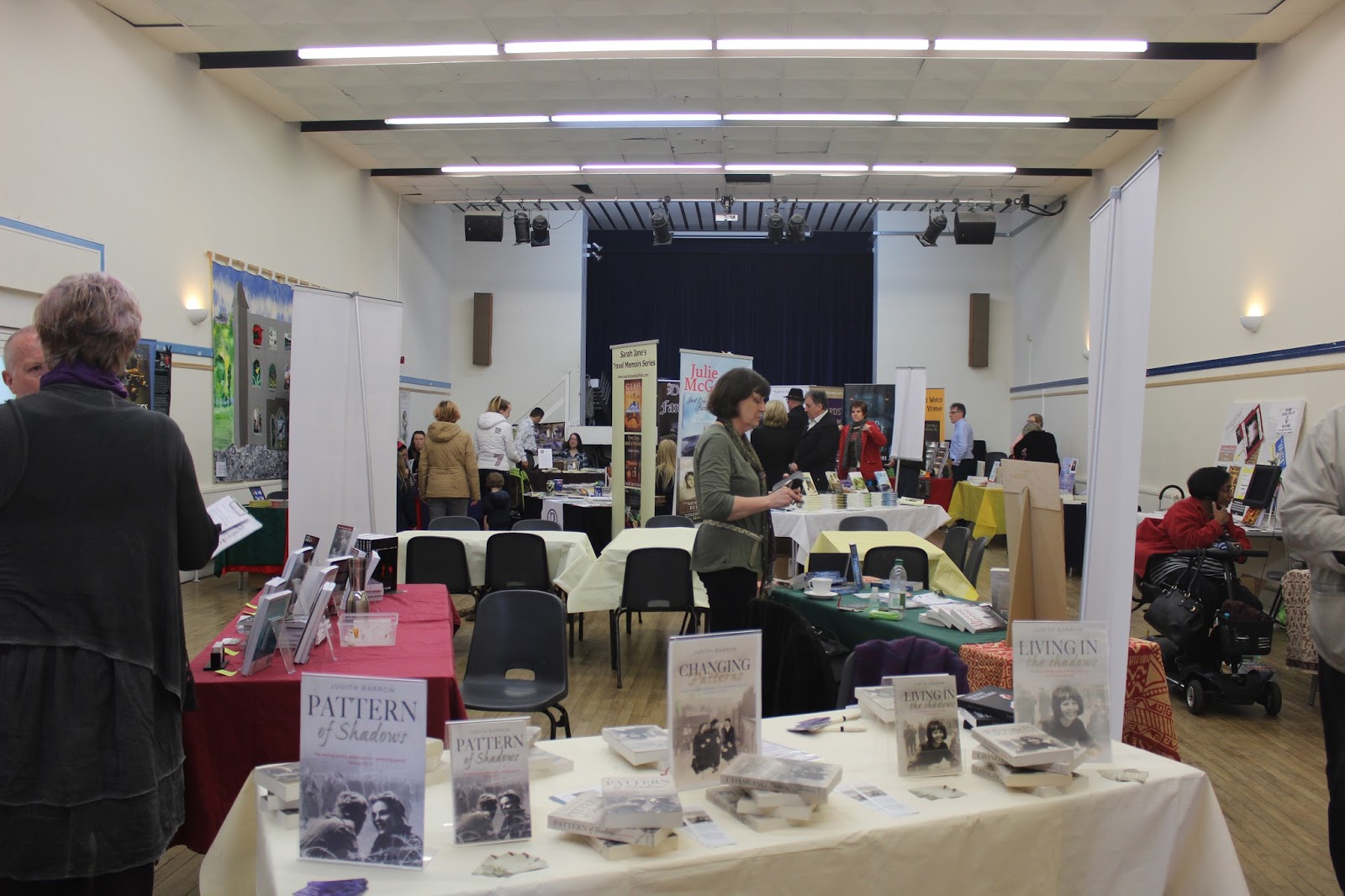
The Joy of Book Fairs

Christoph Fischer and Me 
I attended my first book fair on Saturday. I have been to Christmas Fairs before and I attend Raglan Castle’s annual Tudor Weekend in the summer where I sell lots of books and meet readers and re-enactors but this was my first proper venture into the world of Book Fairs.
I am a very shy person. I thought I might feel like an amateur. I thought it might be ‘clicky’ or my elaborate Tudor style table layout wouldn’t be appropriate for this type of event. Happily, I was wrong. It was a lovely day.

I had only met two of the other authors previously, and a handful were as yet unseen Facebook contacts; the rest were strangers. I don’t usually like strangers. But now, after Saturday’s book fair, they are friends. More than one confessed to also being nervous and uncertain of what was expected, and this sharing of confidence made me realise that other authors are nothing to be afraid of. They are just ordinary people with stories to share.

We were all brought together by the tireless efforts of Christoph Fischer, a prolific author himself, who provides unflagging support of his fellows. The moment we arrived and began to set up our tables a sort of camaraderie emerged. We helped carry boxes, borrowed tablecloths, admired one another’s posters, peeped between the covers of each other’s books. With so much in common, I knew right away it was going to be a good day.

There were talks. I kicked off with a talk about Tudor portraits. After having made comprehensive prompt notes to help me along, I then forgot my reading glasses and couldn’t read a word. I need not have worried. I realised I would just have to ‘wing it’ and the audience was patient and brilliantly supportive. They offered up intelligent, interesting questions for me to answer about the Tudors. In fact, in the end we ran over the allotted time and some of them joined me at my book table afterwards to continue the discussion.

There were workshops from Judith Barrow (author of the Patterns Trilogy) and Sharon Tregenza who writes children’s fiction. Wendy Steele, author of what she describes as 'fantasy with a dollop of magic,' gave a talk on Fantasy and Magical Realism. Carol Lovekin read from her new release Ghostbird, and Julie McGowan read from Don’t Pass Me By. I was delighted to meet Thorne Moore, whose atmospheric books I really enjoy. At the table near mine was Rebecca Bryn. The evening before I’d started reading her book, The Silence of the Stones, although I’d no idea she would be attending.

There were many, many more authors present, too many to mention in detail but the fair provided something for everyone, all literary tastes catered for.


A steady stream of visitors kept the day interesting. I had many stimulating conversations, gained some news readers and met readers who have been following me since my early days. For me, the most thrilling person to come to my stall and buy my books was a young girl. I don’t know her name but she was no more than twelve, and she reminded me of myself at that age. When her mother handed her the books she purchased, she clutched them to her chest and spoke shyly but with great passion of her love of history. It is always nice to meet a kindred spirit. I told her I’d begun writing when I was her age and hope she went away encouraged to begin to write her own.


To boost our flagging energy local food outlet Iechyd da kept us topped up with tea and coffee and some rather delicious cake. We could not have done without them.


This morning I learned that the Llandeilo Book Fair was so successful, another has been booked for 10th December 2016 – hope to see you there.


Tuesday, 15 March 2016

The life of Margaret Beaufort

Margaret Beaufort in often depicted both in fiction and non-fiction as manipulative, duplicitous, vindictive, sometimes a little mad. In my own book, A Song of Sixpence, she appears in her latter years, an unwelcome mother-in-law in the marriage between Elizabeth of York and Henry VII. Writing from Elizabeth's perspective, Margaret at first appears hardened, unfriendly but as their relationship continues, and Elizabeth produces a string of heirs for the king, Margaret softens, just a little, and their friendship develops. Ultimately, as she has at many deathbeds during her life, Margaret weeps copious tears at her daughter-in-law's demise. 

I could have written her all sweetness and light but I don't believe she was like that. My research shows a woman who lived an incredibly hard life, and difficult lives take their toll. She would have had trust issues, perhaps she learned self-containment was the best policy but Margaret's cool exterior shields a warm and vulnerable heart. Margaret was a good woman; a virtuous, generous soul whose determination to get her son on the throne took guts and strength. 

Women who live such lives often don't have time for niceties, in my experience they can be efficient to the point of rudeness. Margaret would not be one to suffer fools gladly, or tolerate nonsense. Once Henry was on the throne her vast experience and level head enabled her to offer wise and solid advice. She gave freely to charity, endowed universities and hospitals and encouraged theological study. All these characteristics are positives yet she is consistently depicted in the negative, that is, if we believe serious, pious, pro-active, politically motivated women to be negative.

Margaret was no beauty, she was not a simpering, pathetic princess and is therefore difficult to slot into a fictional stereotype. She enters A Song of Sixpence toward the end of her story. She has achieved her ambitions, her goal to put her son, her blood on the throne of England has been realised. Henry has overcome all opposition, the royal nursery is full of children. She is elderly, and as the king's mother afforded the honour of a queen. The key words for the latter part of her life story are : success, triumph, honour. But what about her beginnings?

An excerpt from The Beaufort Bride:

The Lady Margaret

Bletsoe Castle 1449

It is a wild night. Outside, the trees are blackened by rain. They thrash their limbs in a dance of anguish, shedding leaves and twigs across the lawn, but here, at the nursery window, I am safe and dry. I press my hot cheek against cool thick glass and peer into the darkness of the garden.
The shrubs and hedges assume threatening shapes; the yew tree by the gatehouse is a hump of deep black menace. My seven-year-old mind forgets the times my stepsisters and I have happily played there on the green mead in the sunshine; tonight I see only threats, only danger, only demons.
A fistful of raindrops spatters against the window and I draw back with a gasp as a yellow leaf, as large as my face, smacks suddenly onto the glass. I stare at it, stuck there like a hand held up in warning. Do not look, Margaret!
But I do look. I cannot help it. If there is a beast in the garden, I have to see it. I have to witness the moment it leaps from the darkness.
Ever since I can remember the grown-ups have kept secrets from me. I didn’t know my mother had been married before, that my siblings had a different father to mine. It was Oliver who told me, and ever since he has delighted in revealing other, more horrible things. Now, to deny him pleasure, I am determined to learn secrets for myself. Secrets that are sometimes best left undiscovered.

No one tells me when I am made a ward of the Duke of Suffolk, fated to marry whomever he pleases. It is Oliver who breaks the news and, at first, I don’t believe him.
“Don’t be silly,” I scowl. “Stop teasing.”
“Oh, I’m not teasing.”
He slides from his seat and comes skulking toward me, his head thrust forward, a grin of mischief smeared across his dirty face. “You have to do as he says and go happily to your marriage, even if he weds you to a grandfather who will beat you twice daily.”
“He wouldn’t do that.”
I can hear the doubt in my own voice and it spurs him on to greater revelations.
“He can do with you as he wishes and you have to obey him or, if you don’t, you’ll be shut up in the Tower as your father would have been if he hadn’t -”
 A sudden movement and Edith comes to stand beside me. She places her hand on my arm.
“Oliver, be quiet. You are being cruel. Don’t listen to him, Margaret, just ignore him. Why don’t you come and help me sort colours for the tapestry I am planning?”
Edith, my older and favourite sister, grabs my wrist and tries to tug me toward her chair but, drawn to the awfulness of Oliver’s secret, I pull away.
“What do you mean, Oliver? My father in the Tower; what do you mean?”
He stands tall, runs two fingers across his upper lip, presenting a sudden image of how he will look when he is a man with a fine moustache and beard. His head is back and he squints down his long nose with a smirk. He is no longer a companion of the nursery; he is an accuser, a torturer, a devil with wickedness upon his lips.
“Your father was a traitor, waiting to be sent to the Tower. The king was going to chop off his head … but your father sliced his own wrists before he could be taken.”
With a gasp of horror, my stepsisters look up from the hearth where they are sewing. Everyone is looking at me. My cheeks begin to burn. I can feel their eyes boring into me, waiting for my reaction. I cannot move; my ears are ringing. It is as if he has struck me but I manage to raise my chin and clench my lips across my teeth.
Oliver watches my struggle for composure, but his venom is subsiding. He is clearly calculating our mother’s reaction should I run to her with the tale of his sins.
It takes a great deal of effort to shrug my shoulders and turn away as if nothing is amiss. His uncertain laughter follows my stiff-legged journey toward the door. I reach for the latch but before I pass through it, I feel Edith’s hand on my shoulder.
“Margaret, don’t believe him. He heard it from the servants – it is likely just tittle-tattle.”
I look into her kind eyes and read the lie hidden there. She seeks to spare my hurt, but I can tell she believes the story. I try to smile but my mouth goes out of shape, my chin trembling. She places a gentle hand on my coif but I shake it off, cuff away the first tear before it has a chance to drip onto my cheek.

I find Mother just returned from chapel. She halts when she sees me and hands her prayer book to one of her women.
“Margaret? What is the matter? Are you ill?”
I shake my head and perform a wobbly curtsey.
“No Mother, I am well.”
She sits down and beckons me closer, places a hand beneath my chin. She feels my brow for signs of fever, pulls down my lower eye lid and bids me stick out my tongue. I obey, passively waiting while she examines my teeth and looks in my ears.
“You are very pale, and you are trembling. What has happened? Have you been fighting again?”
“No, Mother.” Although I threaten to, I never bear tales of Oliver’s taunting. I search around in my head for a small lie that will explain how I have heard the rumour of my father’s disgrace. “I heard someone talking.”
She sits back, links her fingers and rests her hands on her stomach.
“You should never heed gossip, Margaret.”
“No, I don’t but … they said bad things about my father.”
I watch her face blanch and know without her confirmation that Oliver’s tale is true. Her face squirms unattractively as she tries to school her features into obedience.
“Who have you been listening to?”
“Oh … I – I don’t know. We were playing hide-come-seek and I was hiding in a cupboard when some servants were passing … I couldn’t see who it was.”
I will have to make confession and do penance for such a lie, but I refuse to bear tales. It will only make Oliver resent me more.
“Is it true, Mother?” I step closer. “Was my father a bad man? Did he ... did he …?”
I cannot form the last words and as my fear spills from my eyes, her own composure dissolves. She fumbles for a kerchief, blows her nose.
“Oh, Margaret.” She screws the square of linen into a ball and looks at the ceiling. “Your father was a good man, an honest man but … well, he was not always wise. He made mistakes in France and angered the king. When King Henry refused him an audience, your father fell into despair. I … we are not sure what happened … it was a long time ago, six years.”
I listen to the horrid truth, counting back the years on my fingers. 1443, the year I was born.
“So, if my father was a traitor, are we all disgraced? Am I a disgrace? Am I, Mother?”
She sighs, casts about for her kerchief again and dabs her nose.
“No. Your great uncle, the Cardinal, and your uncle Edmund will ensure we remain in the king’s good graces. You must learn that everything is not black and white, or good and evil. There are many different shades. Your father was neither; he was just a man, and all men make mistakes … even kings.”
The end of her sentence is barely audible. I jerk my head and stare into her eyes, trying to fathom what she means. I have been taught an anointed king is sacrosanct. It has never occurred to me that kings can err.
“So the king was wrong?”
“Mistaken, perhaps, is a better word; an error of judgement.”
“What about us? Is Oliv - are the servants right when they say that I must marry whomever the Duke says?”
She looks around the room, her lashes fluttering like damp butterflies that cannot decide upon which blossom to settle.
“We must all marry where we can, Margaret. A woman is seldom given choice.”
“But what if he picks an old man who will beat me twice a day?”
The words are out before I can stop them, Oliver’s laughter echoing again in my ears. She pauses with the kerchief just below her nose.
“No! Where do you get such ideas, child? Come here.”
I long to slide onto the chair beside her and inhale her sweet herby scent that speaks of security. I wish I could snuggle to her bosom. If she was not big with child I could crawl into her lap as if I were a baby. She places her hand upon her swollen belly. “I suppose it is time I told you of your future. You are an important asset to the Duke but he has chosen very carefully for you.”
“Who will want to marry me when my father was so bad?”
She laughs musically, tilting her head back. “Oh my dear child, do you not realise how rich you are? You are an heiress and will be an asset to any husband. Men have already been seeking the honour of your hand.”
I digest this news slowly. So, Oliver was right. I am to be sold.
“You said ‘chosen’ so the Duke has already decided?”
Her hand, that has been gently rubbing the place where her unborn child is curled, stops suddenly. She smiles and looks down at it. She has felt the child kick – another half-sibling. I will no longer be the smallest. I will no longer be the baby of the family. I pray this child will be kinder than Oliver.
“The Duke fancies you for his son, John, who is destined to be a great man.”
I have seen the Duke of Suffolk many times, the great William de la Pole who has fought so long for the king in France. Oliver says that he has almost single-handedly kept our territories in English hands. He is a favourite of the king, but the populace dislike him and have christened him ‘Jackanapes.’
The duke is a big man, large and rough. I remember when I was little, hiding behind my mother’s chair when he came into her parlour. His giant frame blocked the sun from the window and his laugh made the wine cups rattle on their tray. I am filled with dread that his son will be the same.
“Suppose I do not like him?” I whisper with sickness washing in my belly. Mother smiles and closes one eye before answering conspiratorially.
“Then you will make the best of him, as do all women in our position.”

***

I am happy to announce that Book One of The Beaufort Chronicles: The Beaufort Bride tracks Margaret's life from her beginnings at her mother's house, Bletsoe Castle, through her life in Wales and the trials of her marriage to Edmund Tudor, her widowhood, the birth of Henry and her betrothal to Henry Stafford.

Book Two: The Beaufort Woman illustrates Margaret's development from a child into a young woman. It traces her journey through the wars of the roses, her second widowhood, her marriage to Stanley, and her political manoeuvres through the complexities of the conflict between York and Lancaster. She does not rest until the attainment of her dreams at Bosworth field.

Coming soon in 2016


Book Three details the reign of Henry VII and her role as The King's Mother in establishing, once and for all, the Tudor dynasty.

Book One: The Beaufort Bride . Click here to purchase your copy.


Judith Arnopp is the author of eight historical novels of the Tudor and Medieval period. She also blogs and offers talks on Tudor history. You can visit her webpage for more articles and information

Photographs from Wikimediacommons or author's property.